How to Use AI to Get More Construction Leads Without More Ad Spend
Maybe you’ve been here: you drop $2,400 on a quarter-page Yellow Pages ad. Spring for the bold border and everything. Then the calls you get are mostly price shoppers, wrong numbers, and one guy who thinks you’re a florist.
It's a funny story, but it points at something real. The way homeowners find contractors has changed completely and it's changed mostly in the last two years. They're not flipping through a book. They're not even just Googling anymore. They're asking their phones, their smart speakers, and increasingly, they're asking AI. If your business isn't showing up in those answers, you're invisible to a growing chunk of your market.
The good news: you don't need to be a tech person to fix this. You need a system, and most of it is free.
If you want a quick run down of this content, head over to our YouTube and Nick Garcia will break it down in layman’s terms:
What SEO, AEO, and GEO actually mean for contractors
Before getting into the steps, it helps to get the acronyms out of the way. Think of it like building a house.
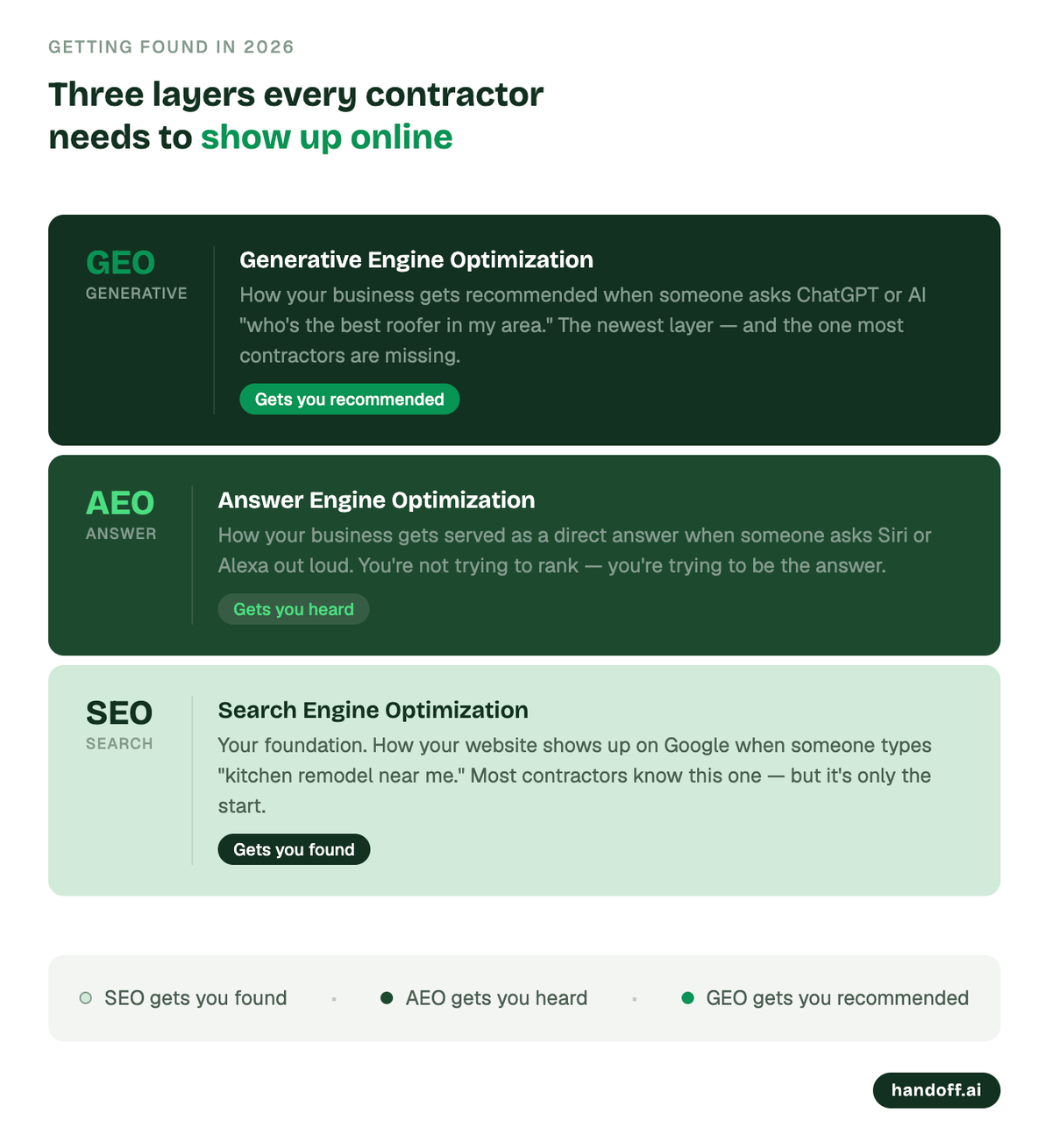
- SEO (search engine optimization) is your foundation. It's how your website shows up on Google when someone types "kitchen remodel near me." Most contractors have heard of this one.
- AEO (answer engine optimization) is your framing. It's how your business gets served as a direct answer when someone asks Siri or Alexa a question out loud. You're not just trying to rank — you're trying to be the answer.
- GEO (generative engine optimization) is your finished work. It's how your business gets recommended by AI tools like ChatGPT when someone asks "who's the best roofer in my area." This one is new, and most contractors aren't thinking about it yet.
SEO gets you found. AEO gets you heard. GEO gets you recommended. In 2026, you need all three.
5 steps to build a lead-generating machine using AI
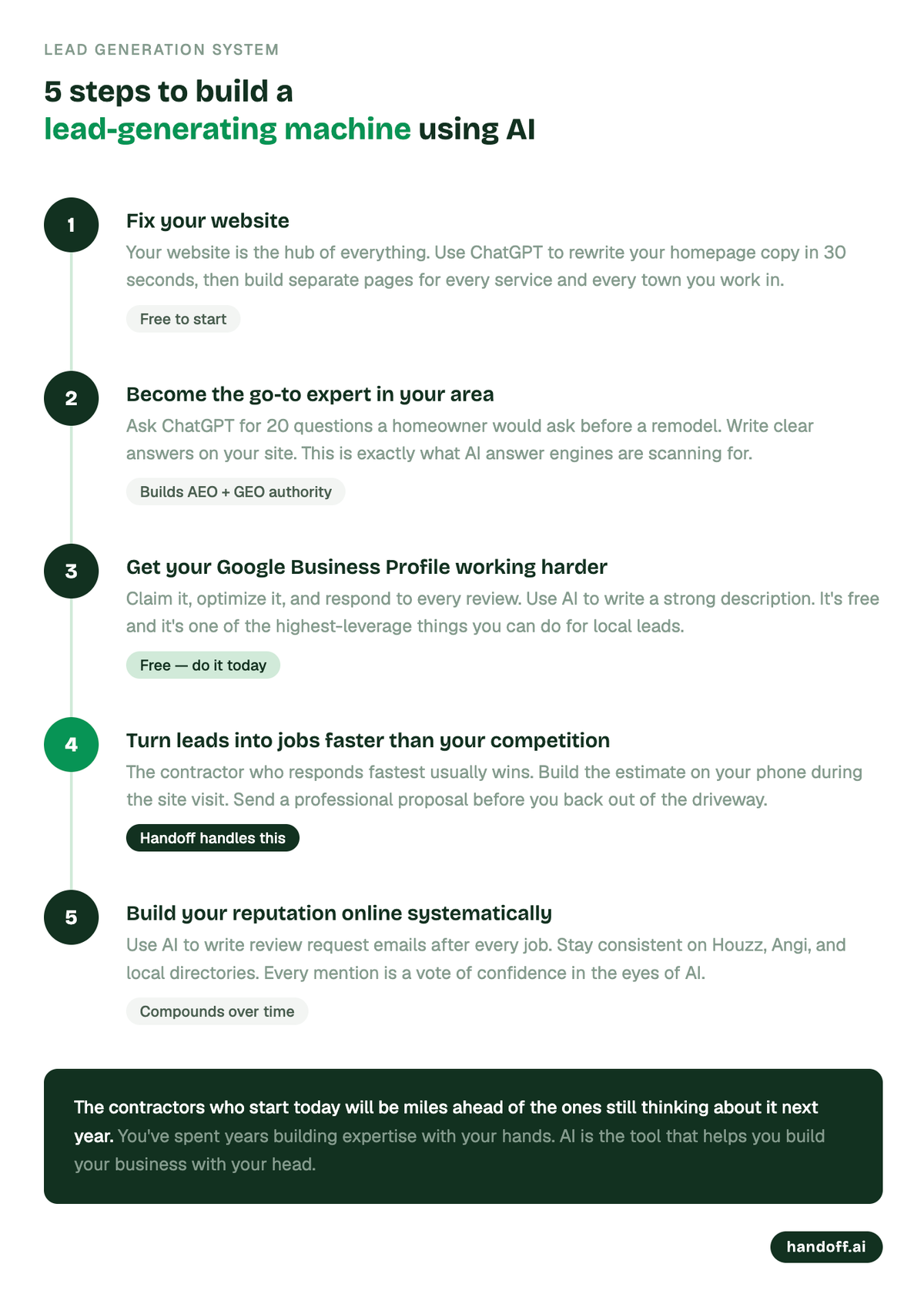
Step 1: Fix your website
Your website is the hub of everything. If it's confusing, slow, or thin on content, you're losing leads before they ever contact you.
Start simple: copy your homepage text, paste it into ChatGPT, and ask it to rewrite it to be more customer-focused. You'll have a better draft in 30 seconds. Then build out separate pages for every service you offer and every town you work in. A page for "bathroom remodel in [city]" does more for local search than a generic services page ever will.
Step 2: Become the go-to expert in your area
People hire contractors they trust. The fastest way to build that trust online is to answer the questions homeowners are already asking.
Ask ChatGPT: "Give me 20 questions a homeowner would ask before starting a basement remodel." That's 20 blog post ideas in 10 seconds. Write clear, plain-language answers on your website. This is exactly what AI answer engines are scanning for when they decide who to recommend.
Step 3: Get your Google Business Profile working harder
If you haven't claimed and optimized your Google Business Profile, do it today. It's free and it's one of the highest-leverage things you can do for local leads.
Use AI to help write a strong business description. Respond to every review you get — positive and negative. Every response builds trust with both homeowners and the AI engines deciding whose business to surface.
Step 4: Turn leads into jobs faster than your competition
The contractor who responds fastest usually wins the job. While your competitors are spending their evenings rebuilding estimates in a spreadsheet, you can have a proposal in a homeowner's inbox before you back out of their driveway.
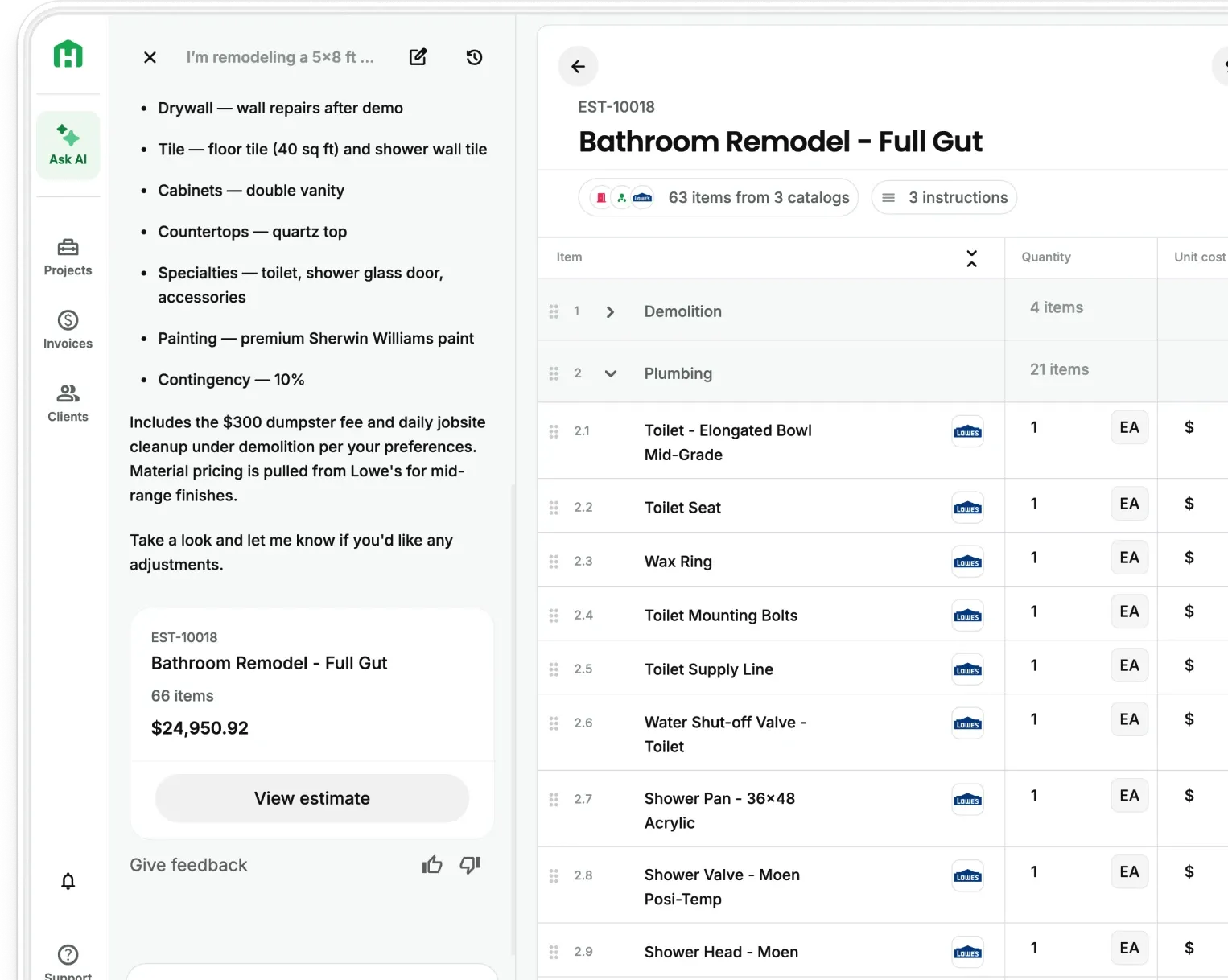
This is where Handoff fits in. When a new lead comes in, it goes straight into project management — no sticky notes, no dropped balls. During the site visit, you build the estimate on your phone. Your AI Teammate transcribes your walkthrough notes automatically. The proposal goes out the same day, professional and detailed, while the homeowner is still thinking about the conversation.
That speed and professionalism is a competitive advantage most contractors in your market don't have yet.
Step 5: Build your reputation online systematically
Online reviews are votes of confidence in the eyes of AI. The more you have — and the more consistently your business name, address, and phone number appear across the web — the more authority you build.
Use AI to write friendly follow-up emails asking for reviews after every completed job. Make sure your business is listed consistently on Houzz, Angi, your local chamber of commerce, and any relevant directories. Every mention reinforces your credibility to the algorithms deciding who to recommend.
One honest thing worth saying
AI is a tool, not a magic wand. If your business has fundamental problems, AI is just going to help you do the wrong things faster.
But if you're a good contractor who needs a better system, these tools become a force multiplier. They take what you're already doing well and amplify it. The contractors who build this infrastructure now will be miles ahead of the ones still thinking about it next year.
Start with one thing. Fix your Google profile this afternoon. Write one blog post this week. Sign up for a Handoff trial and use it on your next site visit.
You've spent years building expertise with your hands. AI is the tool that helps you build your business with your head.
Other FAQs about generating leads as a residential remodeler
What's the difference between SEO, AEO, and GEO for contractors?
SEO (search engine optimization) helps your website show up when someone searches "kitchen remodel near me" on Google. AEO (answer engine optimization) gets your business served as a direct answer when someone asks Siri or Alexa a question out loud. GEO (generative engine optimization) is the newest layer — it's how your business gets recommended when someone asks ChatGPT or another AI tool who to hire. Most contractors have heard of SEO but aren't thinking about AEO or GEO yet. In 2026, all three matter because homeowners are finding contractors through all three channels.
Do I need a big marketing budget to use AI tools for lead generation?
No — most of the highest-leverage steps cost nothing. Claiming and optimizing your Google Business Profile is free. Using ChatGPT to generate blog topics, rewrite your homepage copy, or draft review request emails costs nothing beyond a basic subscription. The investment is time, not budget. Contractors who build this infrastructure consistently over a few months typically see compounding results — more reviews, more content, more mentions across the web — that paid ads can't replicate.
How does responding faster to leads actually win more jobs?
Speed signals professionalism before a homeowner has seen your work. Research consistently shows that the first contractor to follow up with a detailed response has a significant advantage over those who respond hours or days later. When you can send a professional proposal the same day as a site visit — while a competitor is still building their estimate in a spreadsheet — you're not just faster. You're showing the homeowner what working with you will feel like. That impression closes jobs.
How do online reviews affect AI recommendations?
AI tools like ChatGPT and voice assistants pull from publicly available data when deciding who to recommend. A contractor with consistent reviews across Google, Houzz, and Angi — and whose business name, address, and phone number appear consistently across the web — carries more authority in those systems than one with sporadic or missing information. Reviews aren't just social proof for homeowners anymore. They're data points that influence whether AI recommends your business or someone else's.