


The Story That Changed How I Think About Marketing
A few years back, a friend of mine was running a solid GC operation: good crews, quality work, happy customers. His phone rang consistently from referrals and the occasional yard sign. Life was good.
Then a slow winter hit. The referrals dried up. The yard signs disappeared under snow. And he found himself doing something he swore he’d never do: Googling “how to get more contractor leads.”
What he found humbled him.
A competitor two towns over, a guy he actually knew, was showing up at the top of Google for every search that mattered. Not a better contractor. Just better positioned.
He had reviews.
He had a complete Google Business Profile.
He had blog posts answering the exact questions homeowners were searching for.
He was everywhere online…and my friend was nowhere.
That was his wake-up call.
He wasn’t losing to a better contractor. He was losing to a better-marketed one.
So he learned the game. And now he shares everything he knows, GC to GC, so others don’t have to learn it the hard way.
Why Local SEO Still Matters More Than Ever in 2026
Here's the thing nobody tells you: local SEO isn't dying. It's evolving…fast. And if you're not keeping up, you're handing jobs to your competition on a silver platter.
In 2026, the way homeowners find contractors has shifted in three major ways. They're using AI assistants to ask questions out loud. They're trusting Google's AI-generated summaries instead of clicking through websites. And they're making decisions faster than ever, often without ever visiting your website at all.
That means the old playbook:throw up a website, stuff it with keywords, and wait, is officially dead. The new playbook is smarter, and honestly, it's not that complicated once you understand what's happening.
Let's break it down.
The 3 Big Shifts in Local Search You Need to Understand
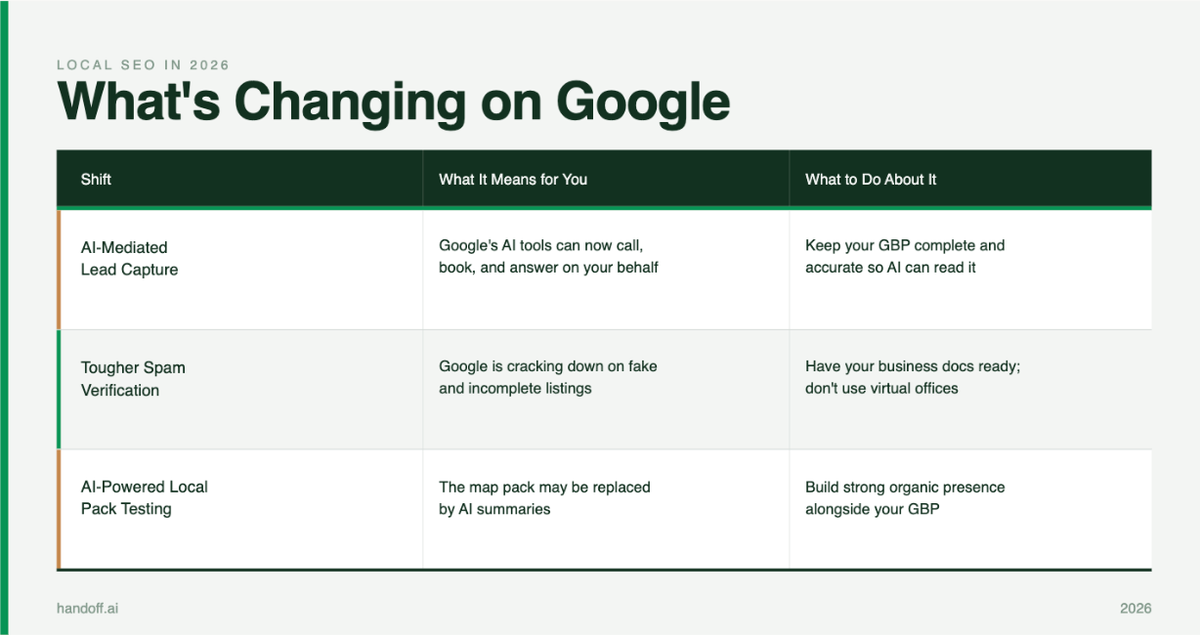
Section 1: AI Is Now the Middleman Between You and Your Next Customer
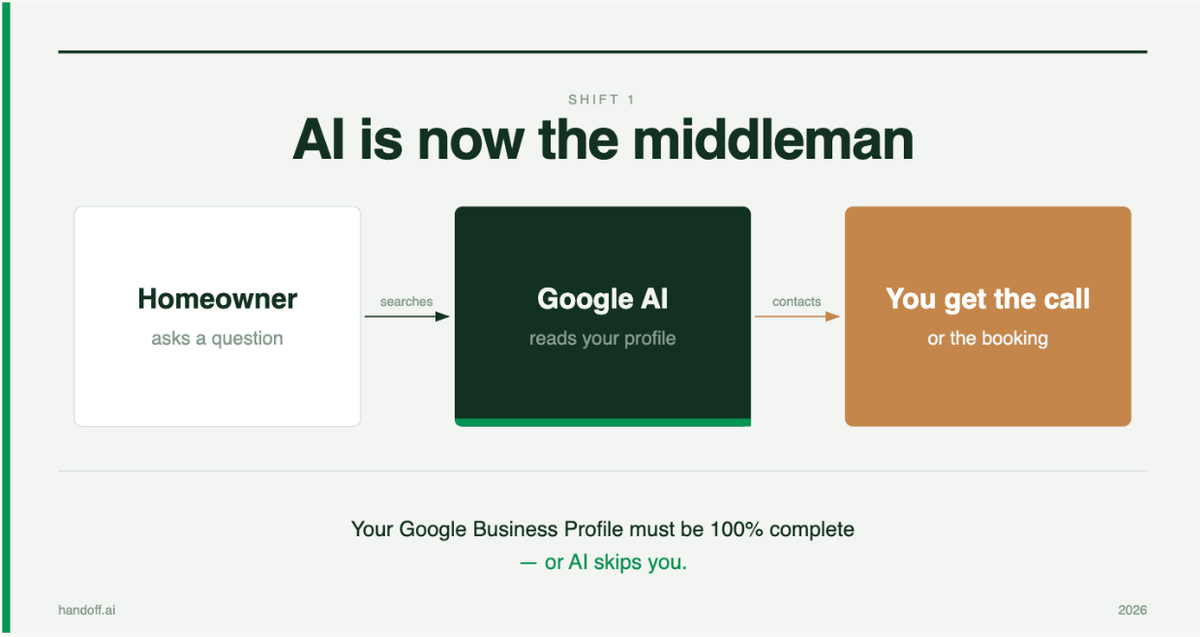
Google has been quietly testing tools like "Have AI Call" and guided booking flows for home service businesses. What this means in plain English: a homeowner searches for a contractor, Google's AI steps in, and it either calls your business or books a job on the homeowner's behalf without the homeowner ever picking up the phone themselves. This is a real-world example of how contractors are using AI to book more jobs.
That sounds great, right? It is, but only if your Google Business Profile is set up correctly. The AI is pulling your service info, your hours, your service areas, and your contact details directly from your profile. If any of that is missing, incomplete, or wrong, the AI skips you and moves on to the next contractor. The goal is to make it easy for homeowners and AI to get recommended by AI tools.
What you need to do right now:
Make sure every single field in your Google Business Profile is filled out. That means your primary and secondary service categories, your complete list of services, your service areas (by city and zip code), your hours of operation (including holiday hours), and your phone number. Think of your GBP as a job application; if you leave sections blank, you don't get the interview.
Section 2: Google Is Playing Hardball With Fake Listings (And That's Good News for You)
In 2025, Google ramped up video verification requirements for new and edited Google Business Profile listings. In 2026, that trend is accelerating. Google is getting serious about removing fake listings, virtual office addresses, and spam profiles that have been cluttering up local search results for years.
This is actually great news for legitimate general contractors. If you're running a real business with a real address, real trucks, and real licenses, you have nothing to fear, as long as you're prepared.
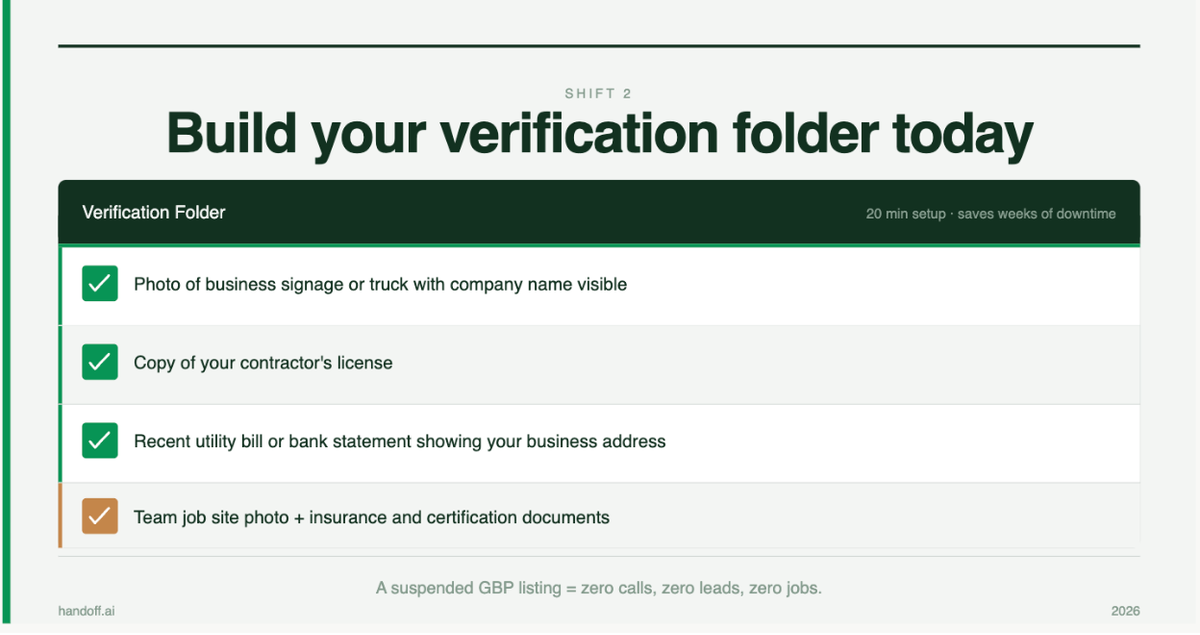
The problem is that most contractors get caught off guard when Google asks them to re-verify. They scramble to find a utility bill, dig through old emails for their license number, and end up getting suspended while they sort it out. A suspended GBP listing means zero visibility in local search. That's zero calls, zero leads, zero jobs. Having all your documents in order is part of your complete digital toolkit.
Build your verification folder today. Seriously, right now. Create a folder on your phone or computer and drop in the following:
A photo of your business signage or truck with your company name visible. A copy of your contractor's license. A recent utility bill or bank statement showing your business address. A photo of your team on a job site. Any certifications or insurance documents.
This takes twenty minutes and could save you from weeks of downtime if Google ever flags your listing.
Section 3: AEO: The New Skill Every GC Needs in 2026
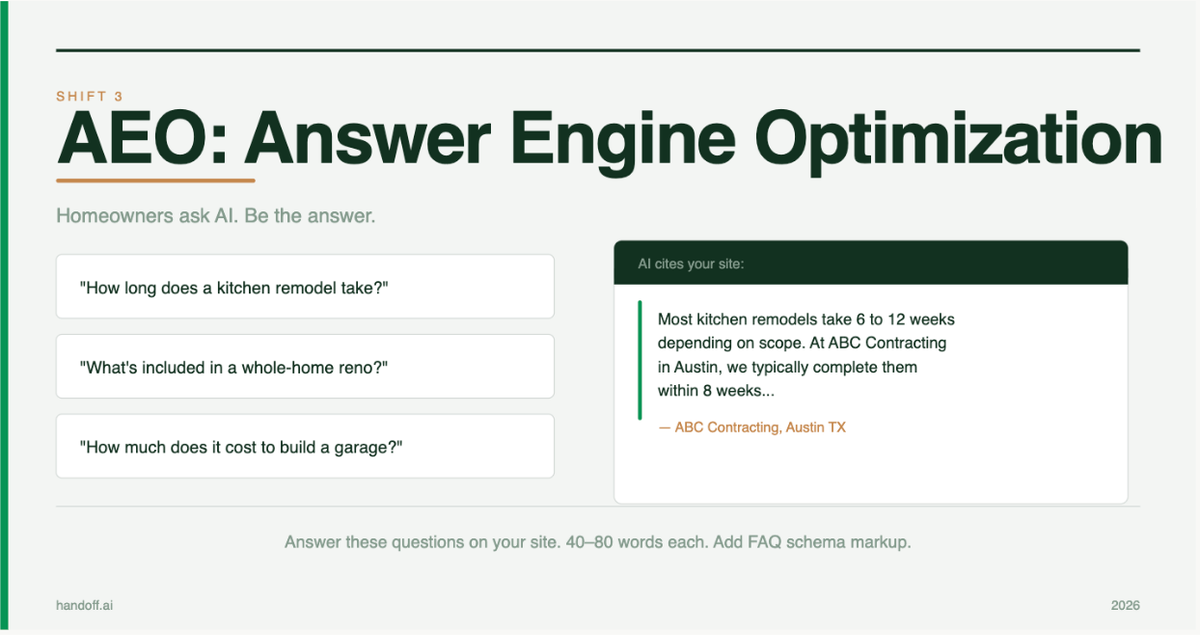
AEO stands for Answer Engine Optimization, and it's quickly becoming just as important as traditional SEO for contractors. This is a core component of AI marketing for contractors.
Here's the shift: homeowners used to Google "general contractor near me" and click through a list of websites. Now, they're asking questions…out loud, to their phones, to ChatGPT, to Google's AI Overview, and getting direct answers. They might never click on a website at all. This is why AI is the future of marketing for GCs.
If your business isn't part of those answers, you're invisible to a growing segment of your potential customers.
The good news is that AEO isn't rocket science. It's about writing content that directly answers the questions your customers are already asking. Think about what comes up on every estimate call:
- "How long does a kitchen remodel take?"
- "What's included in a whole-home renovation?"
- "Do I need a permit for an addition in [city name]?"
- "How much does it cost to build a garage?"
Every one of those questions is an opportunity. Write a clear, direct, helpful answer to each one on your website. Use plain language. Keep each answer between 40 and 80 words for the core response, then expand with more detail below it. Add FAQ schema markup so AI engines can read and cite your content. It's about using AI and SEO together.
The AEO checklist for contractors:
Your website needs proper H1, H2, and H3 heading structure. Your FAQ pages need JSON-LD schema markup. Your content needs to answer specific questions, not just describe your services. Your site needs to be mobile-friendly and load fast. Your business information needs to be consistent across every directory and platform online.
Section 4: GEO Optimization: Prove You're Local, Not Just Listed
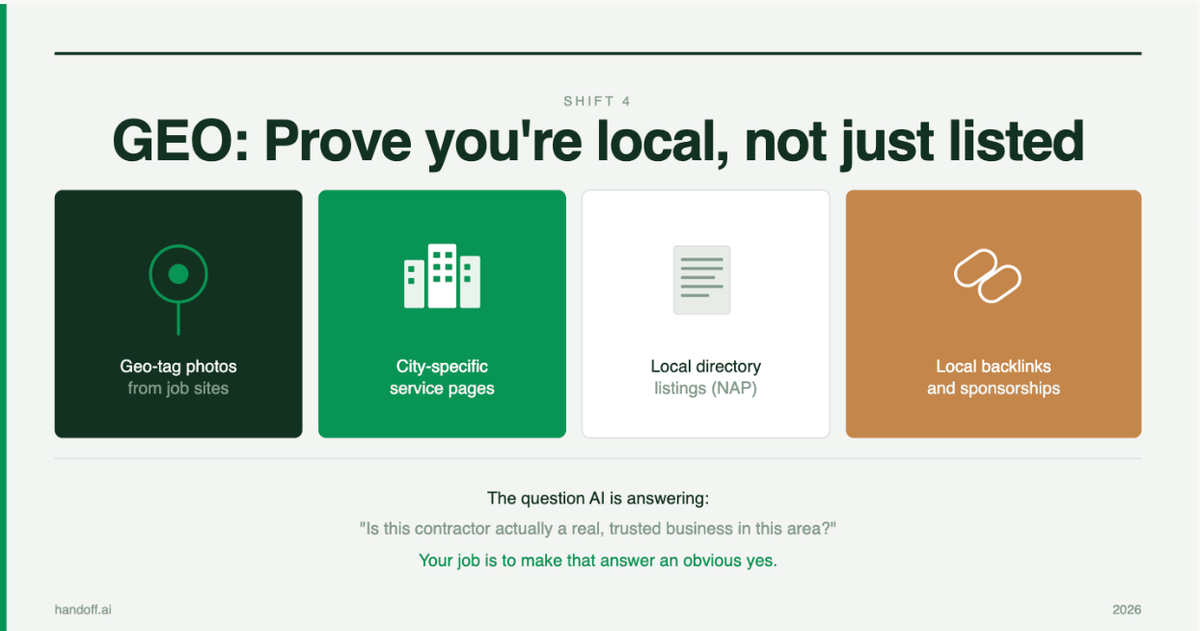
GEO optimization or Generative Engine Optimization, is about making sure AI-powered search engines recognize you as a trusted, authoritative local business. It goes beyond just having a Google Business Profile. It's about building a digital footprint that proves you actually operate in your community.
Think of it this way: Google and AI search engines are trying to answer the question, "Is this contractor actually a real, trusted business in this area?" Your job is to make that answer an obvious yes. A great place to start is to build a lead-generating website.
Here's how to build your local authority:
Geo-tag your job site photos before uploading them to your website or GBP. Most smartphones do this automatically, but it's worth double-checking. When you upload photos of completed projects, the location data embedded in those images tells Google exactly where you work.
Create service area pages on your website. If you serve five cities, you should have five dedicated pages, one for each city, with unique content describing your work in that area. Not copy-pasted fluff, but real information: local permit requirements, common project types in that area, and photos from actual jobs you've done there.
Get listed in local directories. Your local chamber of commerce, the Better Business Bureau, Houzz, Angi, HomeAdvisor, and industry-specific directories all contribute to your local authority. Make sure your name, address, and phone number (NAP) are identical across every single listing. Even small inconsistencies, like "St." versus "Street," can confuse search engines.
Earn local links. Sponsor a local Little League team and get a link from their website. Write a guest post for a local home improvement blog. Partner with a local real estate agent and get a mention on their site. These local backlinks are powerful trust signals for both traditional SEO and AI-powered search. For more on this, check out our local SEO survival guide.
Section 5: Don't Put All Your Leads in One Basket
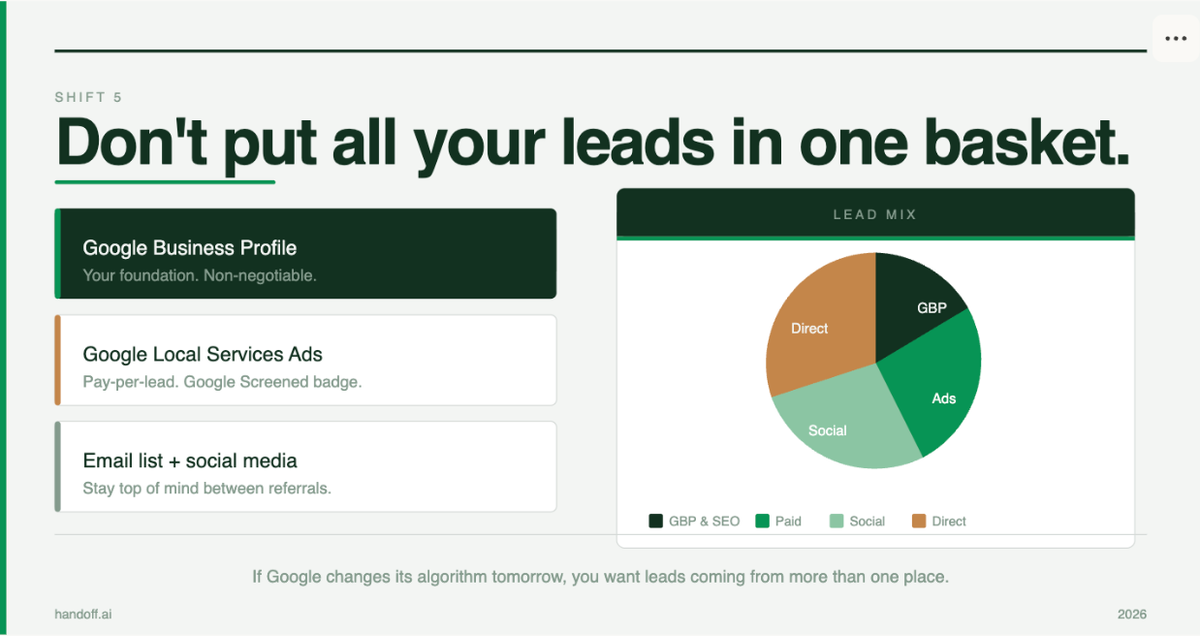
One of the biggest mistakes I see contractors make is relying entirely on one lead source. Whether it's Google organic, the map pack, or a lead generation service, putting all your eggs in one basket is a recipe for disaster.
In 2026, the local search landscape is more fragmented than ever. The traditional map pack may be partially replaced by AI-generated summaries. Organic rankings are being pushed down by AI Overviews. Pay-per-click costs are rising. This is not the time to be dependent on a single channel.
Diversify your lead sources:
Google Business Profile and local SEO should be your foundation. Layer on top of that with Google Local Services Ads for contractors, which are the pay-per-lead ads that appear above the map pack and carry Google's "Google Screened" badge. Build your email list so you can market directly to past customers. Stay active on social media, but not to go viral, but to stay top of mind in your local community. And keep asking for reviews, because they fuel every single one of these channels. You can also explore the best lead generation directories for contractors to find even more opportunities. There are at least 7 ways to get more construction leads that you should be exploring.
The Quick-Win Action Plan: What to Do This Week
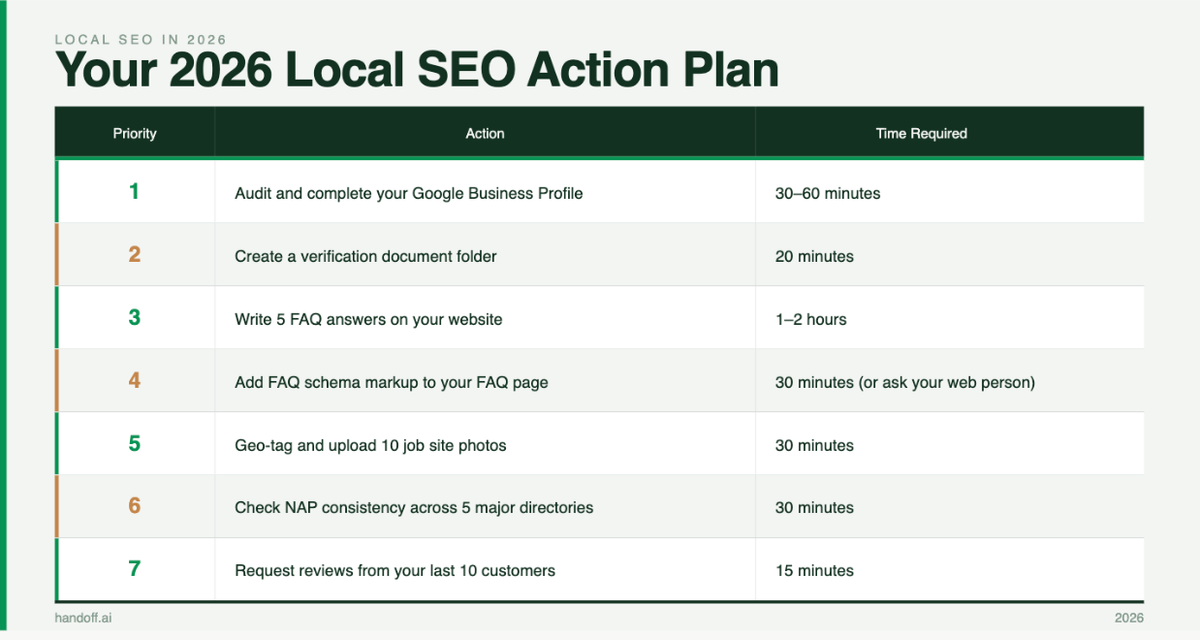
You don't need to overhaul everything at once. Here's a simple, prioritized action plan to get started:
Do these seven things and you'll be ahead of 80% of your competition before the month is out. For a deeper dive, check out these proven marketing strategies for GCs. And if you're stuck on step 7, here's how to ask for a customer review.
Frequently Asked Questions (FAQ)
What is the most important local SEO factor for general contractors in 2026? Your Google Business Profile is still the single most important factor. Make sure every section is complete: services, service areas, hours, photos, and categories. AI-powered tools pull directly from your GBP to generate answers and book leads, so incomplete information means missed opportunities.
What is AEO and why does it matter for contractors? AEO stands for Answer Engine Optimization. It's the practice of structuring your website content so that AI tools like Google's AI Overview, ChatGPT, and voice assistants can find and cite your business when homeowners ask questions. As more people use AI to find contractors, AEO is becoming as important as traditional SEO.
How do I avoid getting suspended on Google Business Profile? Keep your listing accurate and up to date. Avoid using virtual offices, UPS boxes, or co-working spaces as your business address. Build a verification folder with your license, utility bill, business signage photos, and truck photos so you're ready if Google requests re-verification.
What is GEO optimization for contractors? GEO optimization (Generative Engine Optimization) is about building a strong, consistent local digital presence so AI-powered search engines recognize you as a trusted local business. This includes geo-tagging photos, creating city-specific service pages, building local backlinks, and maintaining consistent business information across all directories.
Does local SEO still work in 2026 with AI changing search? Absolutely. The fundamentals of local SEO, a complete GBP, strong reviews, consistent NAP data, and quality local content, are the same signals that power AI-generated search results. If anything, getting the basics right matters more now, because AI is amplifying the gap between businesses that have their act together and those that don't.
The Bottom Line For General Contractors That Are Learning Local SEO
Local SEO for general contractors in 2026 is not about gaming the algorithm. It's about being genuinely findable, genuinely trustworthy, and genuinely helpful, online and off.
The contractors who are going to win the next five years are the ones who treat their digital presence the same way they treat a job site: with attention to detail, consistent effort, and a commitment to doing things right. For a look at what's coming next, check out these 8 remodeler marketing predictions for 2026.
You already know how to build things that last. Now it's time to build a digital presence that does the same.
Ready to win more jobs with less manual work? Try Handoff free →


