


You already know what an estimator does. You've been doing the job yourself for years. The reason you're here isn't because you need a definition. It's because estimating is eating your evenings, your weekends, and your patience — and you're trying to figure out if bringing someone on to own it is finally worth it.
That's the right question. But before you post a job listing, it's worth making sure you're solving the actual problem.
The real reason contractors think about hiring an estimator
It's never really about the estimating. It's about the time.
You're doing site visits during the day, running the job in the afternoon, and writing bids at night. The estimate that should take two hours takes four because you're tired, you keep second-guessing your numbers, and the pricing you pulled last quarter might not be right anymore. By the time you send the proposal, it's been three days since the walkthrough and the homeowner has already talked to two other contractors.
But here's the thing worth sitting with: the problem isn't that you need someone else to do the estimating. The problem is that your estimating process takes too long and costs you jobs because of it. Those are related problems, but they have different solutions.
Hiring a person solves a capacity problem. Fixing the process solves a time problem. Most small remodeling contractors have the second one.
What a manual estimator hire actually costs you
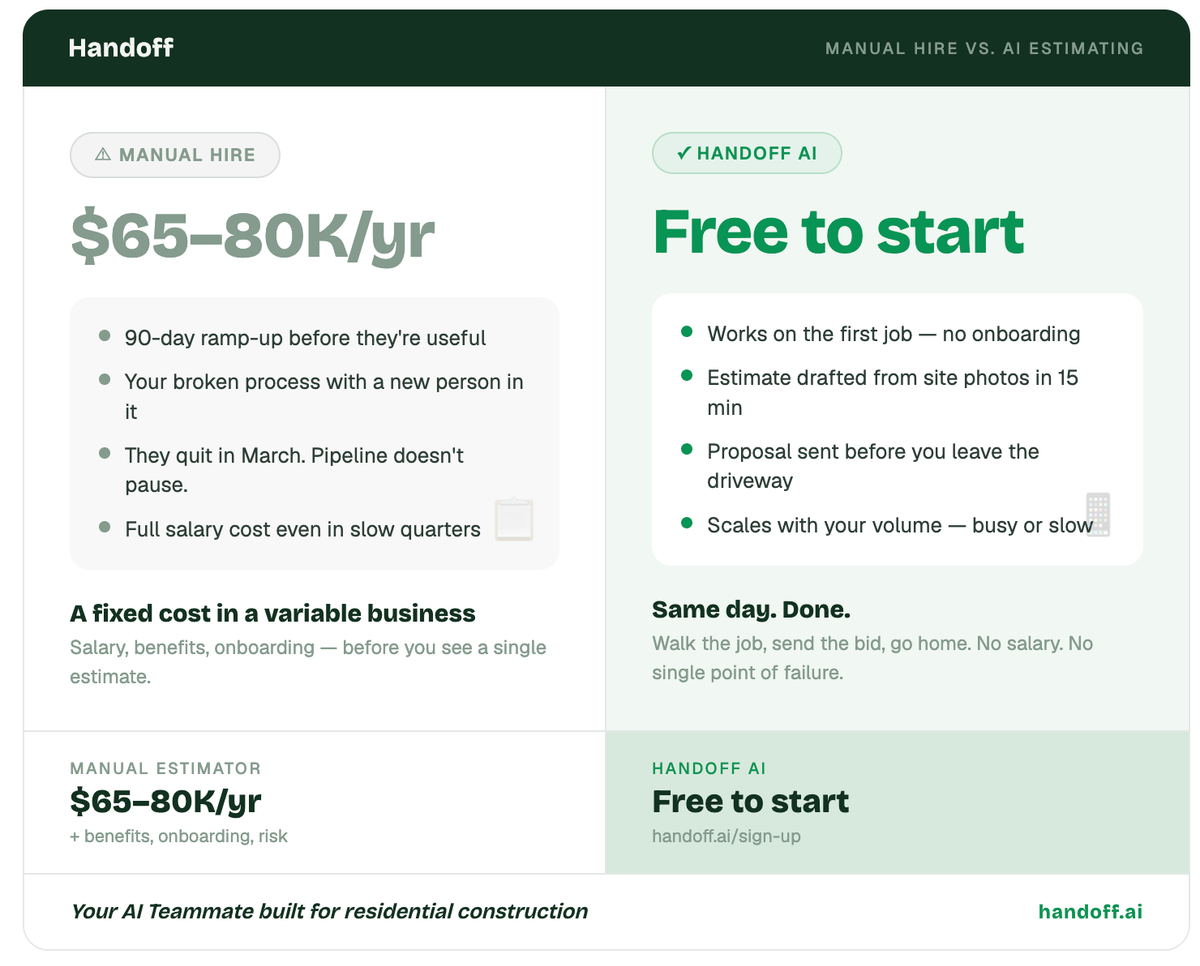
The salary number is the easy part. A solid residential estimating hire runs $65,000–$80,000 a year. That's the number most contractors run in their head when they're deciding whether it pencils out.
Here's what doesn't show up in that calculation.
- Ninety days before they're useful. A new estimator, even an experienced one, needs time to learn your markup structure, your trade relationships, how you scope a bathroom versus a kitchen, and how you like to present to clients. You're paying full salary during that window while you're still reviewing every estimate before it goes out anyway.
- Your process becomes their process. If your estimating is slow and inconsistent right now, an estimator running that same workflow produces slow, inconsistent estimates faster. The hire doesn't fix the system — it just adds a person to it.
- A single point of failure. They get sick during your busiest week. They leave in March. Your pricing logic, your supplier relationships, your institutional knowledge walks out the door with them, and you're back to square one with a new hire and a full pipeline.
- Fixed cost in a variable business. A slow quarter still costs you a full salary. The overhead doesn't flex when the phone goes quiet.
Most contractors who hire an estimator and feel let down are disappointed because the hire didn't solve what they thought it would.
The problem AI estimating actually solves
AI estimators generate a scoped, line-item estimate from your site visit — photos, voice notes, scope description — in about 15 minutes. Your labor rates, your markup, residential-specific line items that reflect how jobs actually get built. You review it, adjust what needs adjusting, and send a branded proposal the same day as the walkthrough.
That's the outcome a new estimating hire is supposed to deliver. Same-day turnaround. Thorough scope. Professional proposal. Without the salary, the onboarding, or the single point of failure.
What that means practically:
- The bid goes out the same day. Most homeowners are talking to three contractors. The first professional proposal they receive sets the baseline. Yours can be that one
- Nothing falls off the scope. Your AI Teammate catches the line items that get missed when you're writing an estimate at 10pm after a full day on the job site
- Your margins hold. Estimates built on current pricing, with your actual markup applied, protect the job before it starts rather than after it's won
- You stop dreading it. You go back to doing what you started this business to do.
The goal is spending less time at your desk, behind a computer screen and more time knowing your numbers are right.
When hiring a construction estimator still makes sense
This isn't a case against hiring. It's a case for being honest about when it actually pencils out.
A dedicated estimator makes sense when bid volume is the bottleneck. When you're consistently winning 40–50% of what you quote and you physically can't get to all the leads coming in. At that scale, the hire pays for itself in jobs you'd otherwise turn away.
We won’t lie to you. Handoff isn’t for commercial construction either.
It makes sense when you're consistently above $10M in revenue and the margin can carry the overhead without stress.
Below that threshold, the economics are harder to make work. And if the real problem is time, not capacity, the math almost never works out the way you hope.
According to NAHB, small residential contractors spend 20–40% of non-billable hours on estimating. That's a cost either way. The question is whether a salary is the most efficient way to get it back.
The version of this that actually works
Most remodeling contractors reading this are somewhere between $500K and $1.5M in revenue. Two or three people on the team. More work than time. Estimating is the thing that keeps them at the desk after everyone else has gone home.
For that contractor, the move is a process that makes the hire unnecessary — at least for now.
- Create your free account at app.handoff.ai/sign-up
- Set your labor rates, markup, and trade categories
- Take Handoff on your next site visit — photos, voice notes, scope
- Review the draft and send the proposal before you leave the driveway
The estimate that goes out tonight wins the job tomorrow. That's what an estimator is supposed to do for you. Your AI Teammate does it without the overhead.
FAQ
Is AI estimating accurate enough to replace a human estimator?
For the core of most small remodeling businesses — kitchens, bathrooms, decks, flooring, additions — yes. The accuracy on standard residential scope is strong when you give it good inputs: thorough site photos, clear scope notes, and your actual labor rates loaded in. For highly complex or unusual projects, the AI draft is a strong starting point you refine, not a finished estimate you send cold.
What if I'm not tech-savvy enough to use AI estimating software?
Most contractors who try Handoff say the same thing afterward: it was easier than they expected. There's no takeoff software to learn, no complex setup, and no data entry to get started — you take photos on your site visit the same way you already do, add voice notes about the scope, and your AI Teammate turns that into a draft estimate. If you can text a photo, you can use Handoff. For a plain-spoken look at what the full workflow feels like from site visit to sent proposal, this walkthrough covers it step by step
How is AI estimating different from just using a spreadsheet template?
A spreadsheet template is only as current as the last time you updated it — and most contractors are working off pricing that's 6 to 18 months old without realizing it. AI estimating generates a fresh, scoped estimate from your actual site visit every time, with current pricing built in. It also catches the line items that fall off a template when you're tired and moving fast. For a deeper look at where spreadsheets break down and what the switch actually looks like, this walkthrough covers it.


