You walked the kitchen, took the measurements, and priced it honestly. Your number came in at $52,000. Two weeks later the homeowner tells you they went with someone at $44,000.
You know what that other guy missed. You’ve done enough of these to know the demo alone will eat half his contingency. But you never got the chance to say any of that, because by the time the three bids landed on the kitchen table, the only thing the homeowner could actually compare was the number at the bottom.
Here are a couple ways to build trust around your higher bid.
6 things to tell your customer when your bid is higher than everyone else’s
#1: Remind them that your margin is thinner than the homeowner thinks
Homeowners assume contractors are keeping a big piece of the job. The numbers say otherwise.
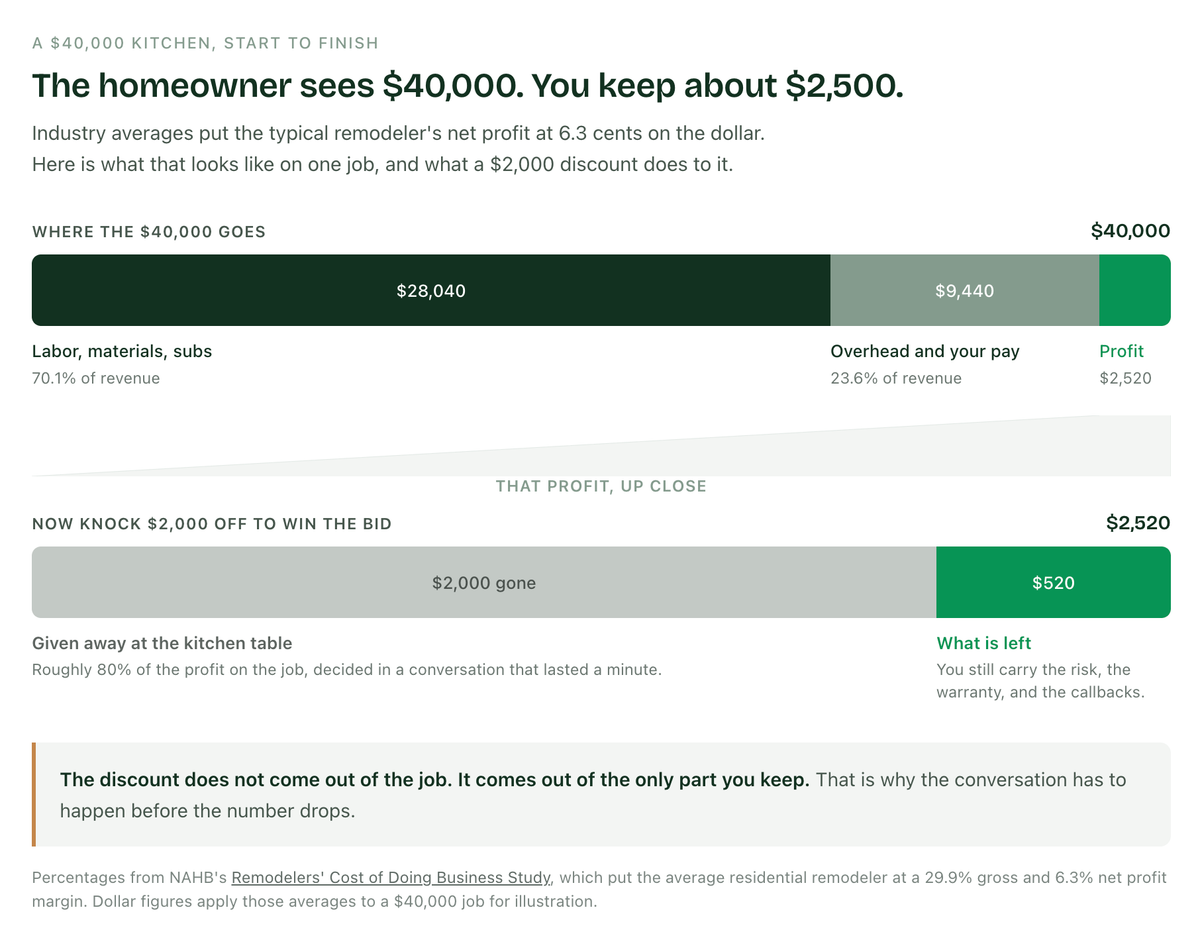
According to NAHB's Remodelers' Cost of Doing Business Study, residential remodelers averaged a 29.9% gross profit margin and a 6.3% net profit margin. That net number was the highest since 1996.
Run that against a discount. Knock $2,000 off to beat the other bid and you just gave away roughly 80% of the profit on the job. You still carry all the risk, all the warranty, and all the callbacks. You are working for free and calling it a win.
This is why the conversation has to happen before the discount does. Once you drop the number, you have no room left to defend anything.
#2: “Costs went up and they are not coming back down”
Qualified Remodeler’s 2026 cost analysis describes a cost structure that looks nothing like it did before 2020. Material categories stepped up and then stabilized rather than falling back. Labor is structurally tight. Overhead keeps climbing quietly in the background.
Their point is worth repeating to yourself before your next bid walk: stable does not mean cheap.
Meanwhile the market is cooling.
Harvard's Joint Center for Housing Studies projects remodeling spending growth slowing to 0.5% by the second quarter of 2027, which is positive on paper but below inflation. Fewer projects, more contractors chasing them, higher costs on every one.
So you are raising prices in a market that is getting harder to win work in. That’s the squeeze. So you need better documentation to get out of the hassle.
#3: Itemize honestly and compare the bids
Homeowners think they’re comparing three prices for the same job. But they’re actually comparing three completely different scopes that happen to have prices attached. One bid has a $3,000 tile allowance. One has none and will bill it later. One includes permits, one buries them, one forgot them. One accounts for the subfloor that is definitely rotted under that dishwasher and two do not.
Your job in the proposal is to make that difference visible without saying a word about your competitors.
The move is specificity. When your bid names the tile line, the permit fee, the dumpster, and the two days of framing repair you already know are coming, the homeowner starts reading the other bids differently. They go back and notice how much white space is on those pages. You don’t have to attack anybody. All you did was show your work.
Contractors who itemize honestly win more jobs at full price than contractors who defend a lump sum.

#4: Put the hard number in writing before they ask
Most contractors bury the uncomfortable parts of a job and hope nobody asks. That instinct costs you.
If you know the subfloor is questionable, write it in. Give it a line, give it a number, and say plainly what happens if it turns out fine. If the electrical panel is going to need work to carry the new circuits, say so in the proposal instead of in a change order six weeks later.
Two things happen when you do this.
- The homeowner sees that you actually looked at their house.
- When the other contractor's change order shows up in month two, they remember which one of you told them the truth up front.
That is also the cheapest insurance you can buy against the nickel-and-dime fight later. If you want the full paper trail version of this, we broke it down in 4 documents that stop subs from nickel-and-diming you.
#5: Say the price out loud before they do
The worst version of this conversation is the one that happens by email three days after you send the bid.
Walk them through it in person or on the phone. Start with the number, do not creep up on it. Something as plain as this works: "It came to $52,000. Let me show you where it goes, and then tell me what you are seeing from the others."
That last part invites them to compare out loud, which lets you find the gap while you’re still in the room. Nine times out of ten, the cheaper bid is missing something specific, and the homeowner will tell you what it is without meaning to.
If price objections are where most of your bids die, these five common objections and how to answer them go deeper on the conversation itself.
Getting there first is part of the justification
When your proposal is the first one on the table, you set the standard the other two get measured against. When it shows up eight days later, you are the guy who took eight days, and every detail you included reads as an excuse for the delay.
Forrest Tlustos, a solo GC in Tucson, used to lose two weeks turning around his bigger estimates. Now he builds them from the truck and shows up with two options already done while his competitors are still returning the first call. Same numbers. Very different position in the homeowner’s mind.
Speed is not a discount. It is proof that you run a real operation, and it is the one thing a homeowner can evaluate before the work ever starts.
What this actually looks like on your next bid
None of this requires you to become a salesperson. But you do have to to do more work than putting a number on a page.
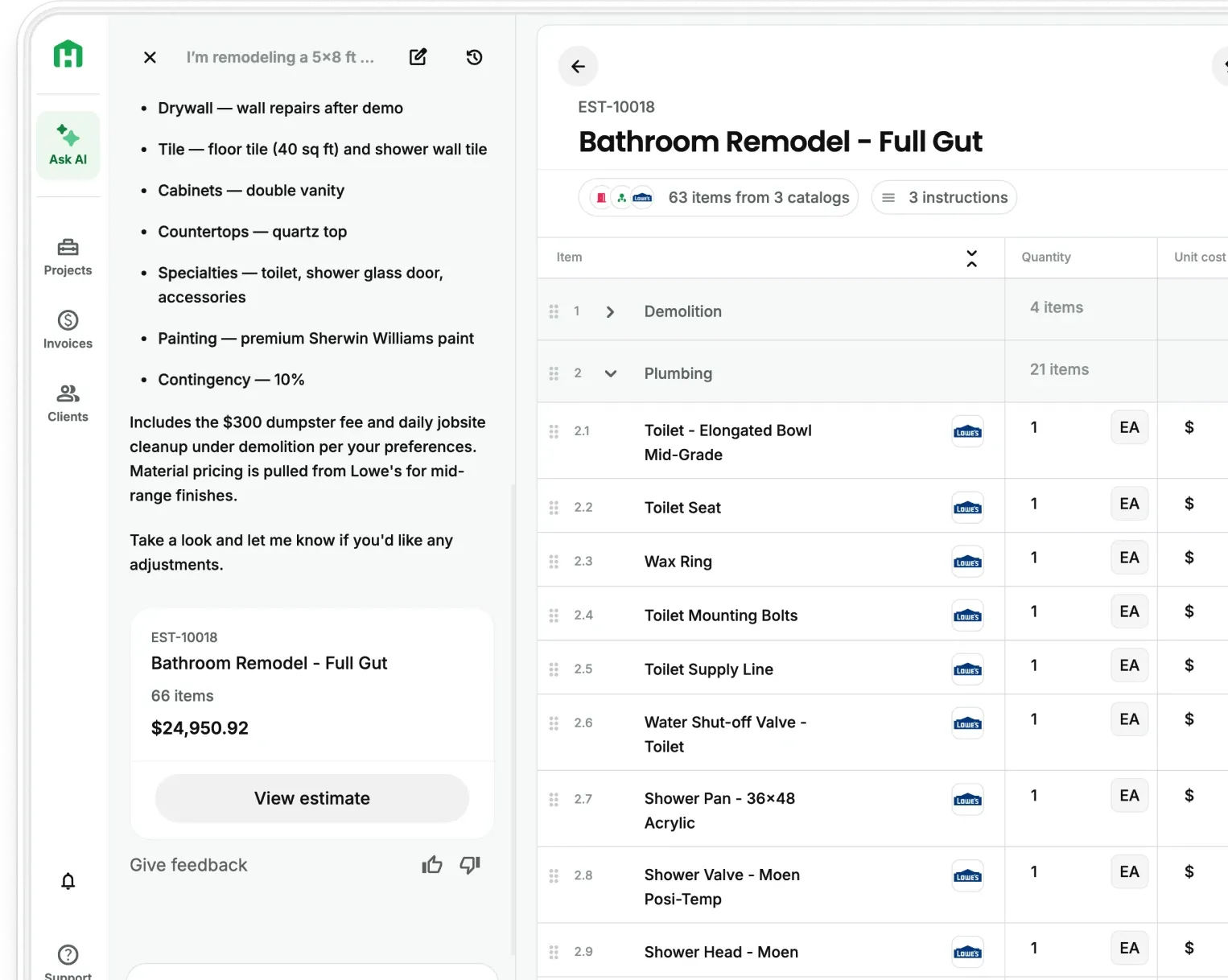
Your AI Teammate builds the itemized version from your walkthrough notes and photos, prices it against live regional supplier data, and gives you a client-ready proposal the same day you looked at the job. The detail that wins the comparison is already in there.
Here is how to start:
- Create your free Handoff account at app.handoff.ai/sign-up
- Upload the photos, notes, or voice memo from your next walkthrough
- Review the itemized estimate and adjust anything you price differently
- Add the line items you know are coming, like subfloor repair or panel work
- Send the proposal before you leave the driveway
Stop losing bids because the customer says “your bid is too high.” Show your works so they can see what’s included in price. Handoff makes the difference visible.
Other FAQs about winning jobs with higher bids than the competition
Should you show your markup to a homeowner?
Showing your markup as a separate line invites the homeowner to negotiate it, which is a conversation you will not win. Build your markup into the line item pricing instead and present a total the homeowner can evaluate against scope. Being transparent about what is included is what earns trust. Being transparent about your profit margin just gives them a target.
What do you say when a homeowner asks you to match a lower bid?
Ask them to send you the other proposal before you answer. Nine times out of ten you will find a missing line, a smaller allowance, or an exclusion they did not notice, and pointing to it is far stronger than defending your own number. If the scopes really are identical and you still cannot match it, say so plainly and let the job go.
How do you tell a homeowner the job will cost more than they budgeted?
Tell them in the driveway, not four days later in a PDF. Name what is driving the gap, whether that is the cabinets they picked, the panel upgrade, or the floor that has to come up to move the sink. Then give them a choice instead of a verdict: show the job at their budget next to the job they described, and let them see the difference in writing. Never quietly trim scope to hit their number, because that job ends in change orders and a review you do not want. Homeowners can handle a higher price. What they cannot handle is finding out late.