


Profit is the dollars you keep from a job. Margin is those same dollars shown as a share of the price you charged. A $40,000 kitchen that leaves you $3,200 after every bill is paid made $3,200 in profit at an 8% net margin. You protect that margin in the estimate: you price from the margin you need, you count your overhead and your own pay, and you carry that same number through labor, allowances, and change orders.
Ask a remodeler what a job sold for and you'll get an answer right away. Ask what it left behind after overhead and there's usually a pause. This breakdown closes that gap, one line of the estimate at a time.
Profit vs margin: what's the difference for contractors
Profit is money; margin is a ratio. Profit tells you how many dollars a job put in your pocket. Margin tells you how many cents you kept out of every dollar the client paid.
Here's how they work on the same job:
- Profit: price minus cost. Sell a bathroom for $25,000 with $18,000 in costs and you made $7,000.
- Margin: profit divided by price. That same $7,000 on a $25,000 price is a 28% margin.
- Why you need both: profit tells you if this job paid; margin tells you if your pricing works. A $60,000 addition can make more profit than a $25,000 bath and still run a thinner margin.
Margin is the number you can set on every bid and compare across every job, big or small. If you've been mixing up margin and markup, our guide on markup vs margin clears that up first.
Big picture takeaway: Contractors who price by margin know what a job will leave behind before they sign it.
Gross profit vs net profit on a remodeling job
Gross profit is what's left after the job's direct costs: materials, labor, and subs. Net profit is what's left after you also cover overhead: the truck, insurance, software, marketing, the office, and your own salary.
Here's one $40,000 kitchen, start to finish:
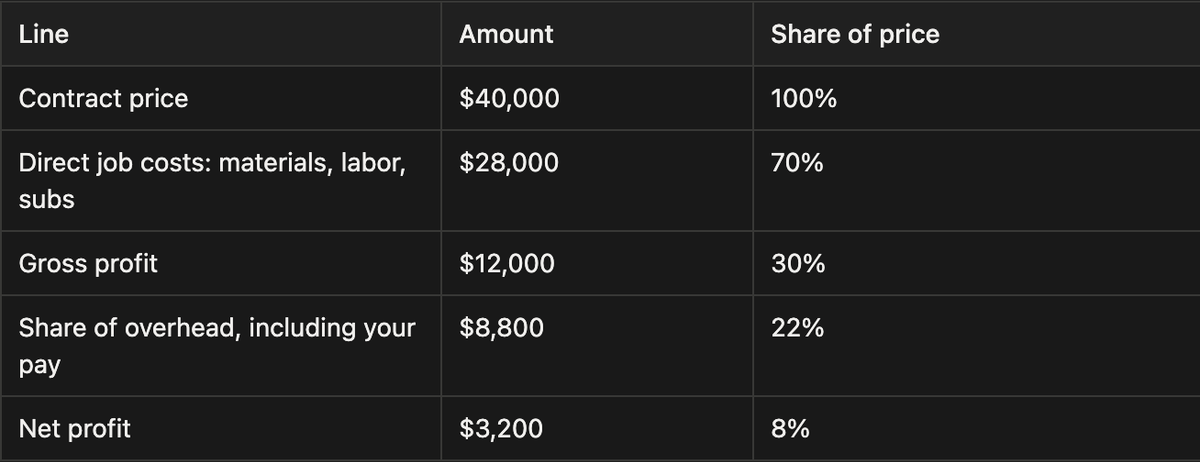
That 30% gross margin looks healthy on paper; most of it is already spoken for. The National Association of Home Builders counts owner's compensation as an operating expense, so if your pay isn't in your overhead number, your "profit" is really your paycheck.
Remodelers averaged a 29.9% gross margin, then spent 23.6% of revenue on operating expenses, leaving 6.3% net. It's the best net result the study has recorded since 1996, and it still means about six cents of every dollar stays with the business.
NAHB's 2026 Remodelers' Cost of Doing Business Study
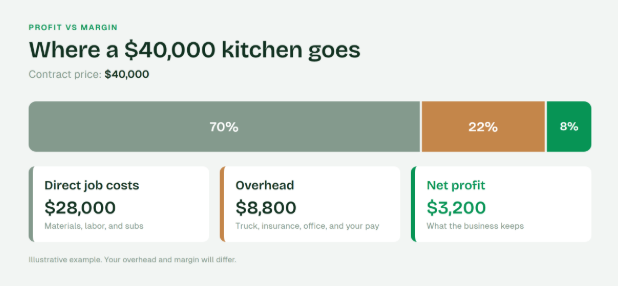
When you know both numbers, you know which one to fix: gross margin gets fixed in the estimate; net margin gets fixed in the estimate and in your overhead.
What’s a “good” profit margin for a remodeling contractor?
A good gross margin is your overhead percentage plus the net profit you want to keep. If overhead runs 22% of revenue and you want 8% net, every job needs about a 30% gross margin.
The average is a starting point; your shop sets the real target:
- Industry average: NAHB's latest study puts remodelers at 29.9% gross and 6.3% net. Useful for context; risky as a target.
- Overhead range: longtime remodeling consultant Michael Stone puts typical remodeler overhead anywhere from 25% to 54% of revenue. A shop at 35% overhead that prices to the 30% average loses money on every job.
- Job size: a $12,000 bath still needs a site visit, an estimate, permits, and client calls. Small jobs usually need a higher margin to carry the same fixed work.
Find your overhead number once and the right margin stops being a guess. Our guide to business expense categories for remodelers shows what to count.
Why remodelers lose margin between the estimate and the final invoice
Overhead doesn't shrink when a job runs over, so every dollar you miss comes out of net profit first. That's why a few points of gross margin can wipe out most of what you planned to keep.
Go back to the $40,000 kitchen. Say the crew runs $1,000 over on labor and you eat a $1,500 scope item nobody priced. Gross profit drops from $12,000 to $9,500; still about 24%, which doesn't sound bad. Net profit drops from $3,200 to $700. You gave up more than three-quarters of your take-home on a $2,500 miss.
[@Sebastian Tablante let’s build a GIF here using the $40,000 bar from the image above. The net profit segment shrinks from $3,200 to $700 as two labels drop in: "+$1,000 labor overrun" and "+$1,500 missed scope." End frame: "Gross margin: 30% to 24%. Net profit: $3,200 to $700."]
The usual leaks show up in the same places:
- Labor priced at the wage: an hour of labor costs more than the paycheck. The Bureau of Labor Statistics found benefits make up about 30% of what private employers spend per hour worked; payroll taxes, workers' comp, and time off belong in your labor rate.
- Scope missed on the walkthrough: the outlet you didn't count, the subfloor you didn't check. See how to handle job add-ons and delays.
- Stale material prices: a price from last month's job can be wrong by the time you order.
- Free change orders: "while you're here" work done on a handshake, or priced below your margin. Our guide to change orders covers the paperwork.
Accurate estimates protect contractor margins from the start, because the margin you lose on the job was usually missing from the bid.
How to build an estimate with your margin in mind
Set your target gross margin first, then price every line so the total lands on it. That means knowing your overhead, burdening your labor, pricing the unknowns, and holding the same margin on change orders.
- Find your overhead percentage. Add up 12 months of overhead, including your own salary, and divide by revenue. $220,000 in overhead on $1,000,000 in sales is 22%.
- Pick your net profit target. Choose what you want to keep after everything; the 6.3% industry average is a floor to beat.
- Add them together. 22% overhead plus 8% net is a 30% target gross margin.
- Price from the margin. Price equals direct cost divided by one minus your margin: $28,000 ÷ 0.70 = $40,000. A 30% markup on $28,000 only gets you $36,400.
- Burden your labor. Price each hour at wage plus payroll taxes, workers' comp, insurance, and paid time off; the Time Tracking data from past jobs tells you how many hours to expect.
- Price the unknowns. Put a dollar amount on every allowance and add contingency where you can't see: older homes, wet areas, anything behind drywall.
- Hold the margin on change orders. Price every change at the same margin and get it signed before the work starts.
"Every business must make a profit or it will go away."
Michael Stone, author of Markup & Profit Revisited
Build the estimate this way once and your margin is set before the client ever sees a number. For the markup side of the math, see how to set your first markup.
Construction estimating software that protects your margin
The right estimating software builds your margin into every line, prices materials from current supplier data, and keeps comparing actual costs to the estimate while the job runs. That's the difference between knowing your margin and finding out at tax time.
Here's what your AI Teammate handles in Handoff:
- Margin built into every estimate: set default markups for labor, materials, and other costs once, and they apply to every new estimate; the estimate breakdown keeps markups, taxes, and discounts separate so you see exactly what you keep.
- Current material prices: AI Estimates pull local pricing from suppliers like Home Depot and Lowe's, so your margin sits on numbers that haven't expired.
- Estimate to live budget: AI Budget Tracking turns the approved estimate into the job budget, matches receipts to line items, and shows budget vs actuals and gross profit while the job is active. Available on Handoff Pro.
- Change orders at your margin: AI Change Orders draft the change with pricing so it goes out signed and marked up, not done on a handshake.
Whether you call it construction estimating software or a contractor job tracking app, the job is the same: the margin you bid is the margin you keep. Handoff helps contractors win more jobs at better margins.
Price every job for the margin you need
Your AI Teammate keeps the math steady so you can focus on the work:
- Start your free trial: seven days, no credit card required.
- Set your default markups for labor, materials, and other costs.
- Build an estimate from your walkthrough notes, photos, or plans.
- Check the margin before you send, then track actual costs as the job runs.
Your margin gets decided in the estimate. Handoff helps you decide it on purpose.
Other FAQs about profit and margin for remodelers
Should I include my own salary in overhead?
Yes. NAHB counts owner's compensation as an operating expense, and your pricing should too. If your pay only comes out of net profit, a thin job means you worked for free.
How often should I recalculate my overhead percentage?
At least once a year, and any time something big changes: a new hire, a new truck, a bigger shop, or a slower season. Your overhead percentage moves with both your costs and your sales.
Can I lower my price without giving up my margin?
Yes, by changing the scope instead of the margin. Offer a simpler finish level or a phased option at the same margin. Proposals with multiple options let the client pick a price that fits while your margin holds.


