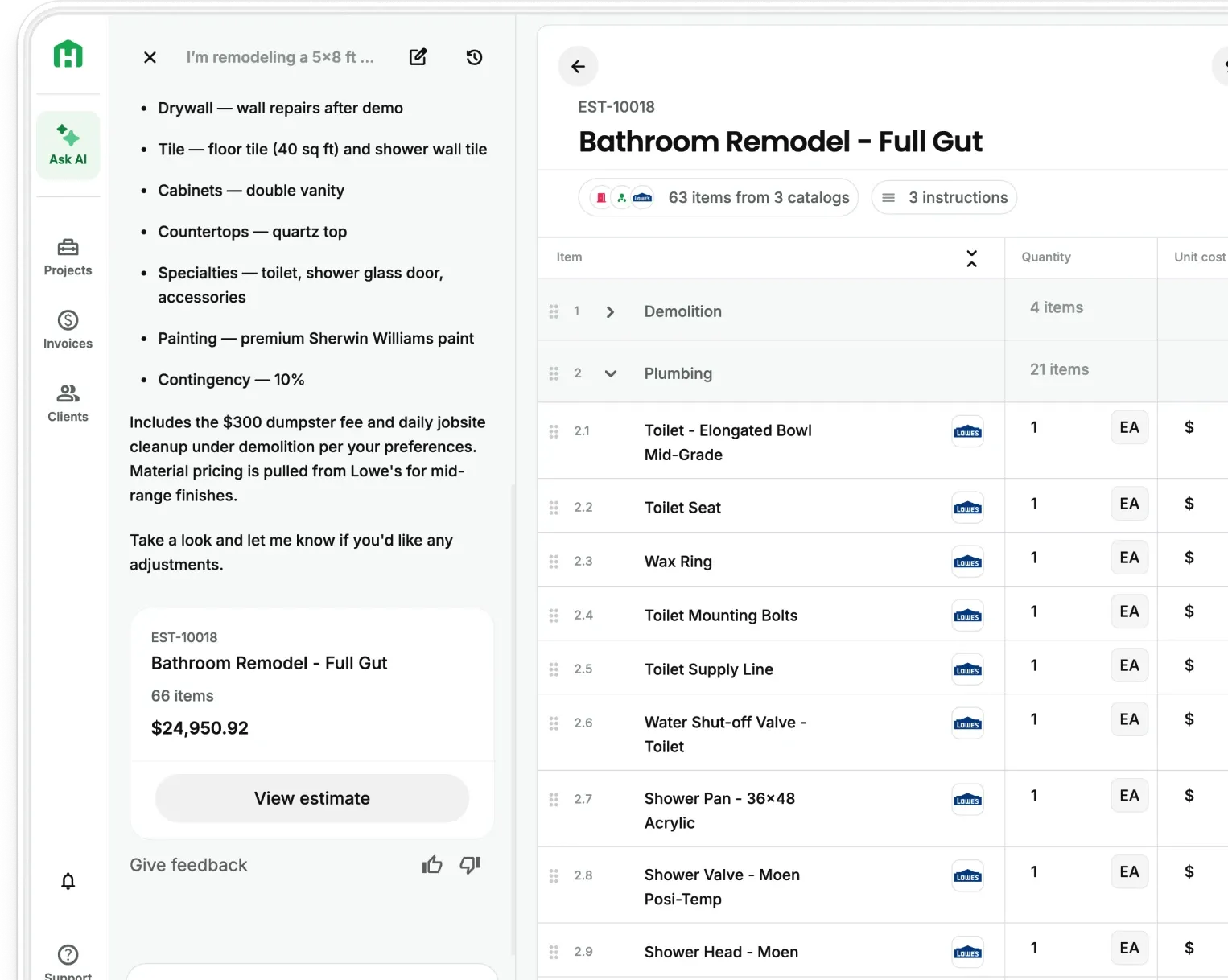
At his busiest, Matt Price was spending close to 20 hours a week writing estimates. He has three kids. He’s the president of football and cheerleading for his town. He coaches football, wrestling, lacrosse, and basketball, and helps out with softball. That’s a lot for one guy.
"It wasn't bad, it's a good problem to have," he says of the volume. But every bathroom he measured turned into another night at the kitchen table with a tape measure's worth of notes and a calculator. An hour per bathroom, sometimes more, because Matt has never been a square-foot guy.
Today that same bathroom takes him 10 to 15 minutes.
The job box
- Contractor: Matt Price, Right Price Remodeling
- Market: Whitman, Massachusetts, serving the South Shore
- In the trades since: Age 11, roughly 26 years
- Business founded: 2021, started as a one-man operation
- Current work: Bathroom and kitchen remodels, tub-to-shower conversions, additions, and ground-up builds
- Estimating time before Handoff: About an hour per bathroom, up to 20 hours a week at peak
- Estimating time now: 10 to 15 minutes per bathroom
More than a name. Pricing jobs right every time
Matt's last name is Price. Growing up, adults never let that go.
"Everyone used to always say, oh, is the price right," he says. "So instead of getting mad, you kind of just take it, you turn it around."
The early slogan was "if you didn't go at Right Price, you paid the wrong price." He has since retired it. The philosophy underneath it stuck.
"We don't want to overcharge anyone. We certainly don't want to undercharge," he says. On a high-end job his company is running now, he knows other shops would quote it far higher simply because it is a high-end job. "We don't want to make a million dollars off of one single job. What we want to do is do a great job for a great price. That way they tell everyone, which will then allow us to grow."
The problem: an hour a bathroom, by hand
When Matt started in 2021, everything was paper.
"I'm very meticulous when it comes down to things," he says. "Some guys will do things by the square foot. They'll charge, hey, it's an 80 square foot bathroom, this is how much it'll be. Not us. We would do the floor tiles, we would do how high are the walls, how much sheetrock, for paint, for this, for that."
That precision is what made him good. It is also what buried him. Measure everything the old fashioned way, drive home, do the math, write it on a piece of paper, drive back to the client. Win or lose, repeat.
He tried other apps along the way. "They did their job, but they weren't anything what I really needed," he says. "I'd start plugging it in, do everything manually. It would make it look professional. I was still doing all the same stuff, but it just looked nicer."
The work hadn’t changed. Only the font had.
The switch: "Wait, that's it?"
Matt found Handoff the way a lot of contractors do, somewhere between a Facebook post and a late-night search for an easier way to write quotes. He started a trial and ran a few jobs through it.
"I put in a few of them and I was like, wait, that's it? That's all I got to do? It's that simple?"
He started from the template estimates and adjusted the numbers to match his business. As insurance went up, as truck payments went up, he adjusted again. The system learned as he went.
"It started learning what we would normally charge," he says. "Even if it wasn't a preset, it would automatically start learning all that stuff, the more you used it."
Why he trusts the numbers: the things he used to forget
Matt was not an early adopter. Handoff was the first AI tool he used at all.
"I was always kind of [skeptical] of it," he says. He compares it to laser measures when they first showed up on job sites. So he did what he did with the laser: checked it against his own work.
"You double check it against your own work and it's like, hey, this is actually really close."
Still, what sold him was realizing the line items he’d been quietly leaving out for years.
"I would never account for screws. I would never account for compound tape or framing nails," he says. "I would, but I wouldn't. I would just think, five dollars for screws." Now those items land in the estimate automatically. "It takes the thinking out of it. It's not like you don't know that you need to use them. It's just you overlook it when you do something so many times."
Those are the items that quietly eat a margin. A crew runs short on screws, a laborer drives 20 minutes each way to the hardware store at $25 an hour, and the rest of the crew slows down waiting.
It also catches inconsistencies he would not have caught himself. On tub-to-shower conversions, which his shop does constantly, "it'll say, that's a weird number from square footage of flooring to the tub, so you're probably going to have to do this. Little things like that that you don't think of."
How to talk to AI, according to Matt
Matt's advice on getting good output is the most quotable thing he said, and the most useful.
"AI is the smartest thing you can use, but you need to talk to it like it's an eight-year-old."
He means it as a compliment to the tool and a warning to the user. Three rules he works by:
- Be thorough, not clever. "You can't just say, write a letter. The more details you give it, the better off you are."
- Describe the actual job, not the job type. "You can go in there and say, I have a five by eight bathroom that I need to remodel, and it's just going to spit out whatever it thinks a five by eight bath remodel needs." Instead: the tub is a Kohler acrylic replacement, the walls are tile at this square footage, the floor is coming up, there may be mold, the baseboards need to come out.
- Feed it your own presets. "The more presets that you put into Handoff, the more it can take your own information just by using your words and build you an estimate in minutes."
His summary: "Crappy questions get crappy answers."
On bid speed, he has a warning
Matt does not believe faster is always better, which is worth hearing from someone whose estimates now take 15 minutes.
"You want to be quick, but you don't want to be like 30 seconds quick," he says. Part of his client base is older and not sold on AI. "They think that like, oh, hey, there's no way. If you can get it out to me in five minutes, there's no way you got everything right."
So he uses the time he saved differently. He double-checks the math. He makes sure the proposal is clear and reads well. Then he follows up, which he calls the real difference-maker.
What it actually changed
Ask Matt what he did with the hours and the answer is not about the business.
"I was able to spend hanging out with my kids and putting it towards the business itself," he says. "Let's face it, estimating is tough. If you get it wrong, you can lose the job. If you're too high, you lose the job. Too low, you lose some money."
He’s blunt about what he would tell a contractor still doing it by hand. Starting a business was already the risk, he points out. This is not.
And on the learning curve, which is the objection he hears most: "It's not like you need to be a scientist to learn Handoff. It's very simple."
His closing line on the episode: "Just try it. Give it one week. That's it. And then you'll never want to go back."
Want your nights back? Start your free trial and run one bathroom through Handoff the way Matt did. Compare it to the estimate you would have written by hand.
Other FAQs about starting your free trial with Handoff
How long should a bathroom remodel estimate take to build?
Matt spent about an hour per bathroom doing it by hand, line by line, and now spends 10 to 15 minutes. The time goes down because the measuring, the pricing lookups, and the consumables get handled for you. The judgment about scope and client fit still takes as long as it always did.
Will AI estimating catch the small material items contractors forget?
That is the part Matt did not expect. Screws, compound tape, and framing nails were items he admits he used to round off or skip entirely. Those items are small individually and add up across a year of jobs, which is where margin quietly goes.
Do I need to be good with technology to use AI estimating?
Matt used no AI at all before Handoff and describes himself as having been skeptical of it. His advice is to be thorough with the details you give it and to check the first few estimates against work you already know. "It's not like you need to be a scientist," he says.