You've probably asked yourself this while staring at a bid you're not sure about. Maybe the AI tool gave you a number that felt low. Maybe it felt high. Either way, you didn't send it. You went back and checked it by hand, the way you always have.
That instinct is worth understanding where it comes from, and whether it still holds up.
You’re asking the wrong question about accuracy
The better question (or maybe the question you’re really asking) is "accurate compared to what."
Most contractors don't measure their current process against your gut, not some benchmark. If a bid feels close enough, it goes out. If a job comes in over budget, you chalk it up to bad luck or a client who kept adding scope. Rarely do you sit down and ask how much of that overrun came from a bad measurement, a missed line item, or a material price that changed while your estimate was still in someone's inbox.
We already walked through the data on this in detail on our blog. The short version: manual estimating has a built-in error rate, whether the error comes from memory, a spreadsheet formula, or pricing that goes stale between when you write the bid and when you win the job. AI estimating tools, when they're purpose-built for construction, tend to close that gap and then some.
But numbers only tell you so much. What actually earns trust is watching the tool get it right, job after job, in your own market.
Trust in AI estimates is built one at a time
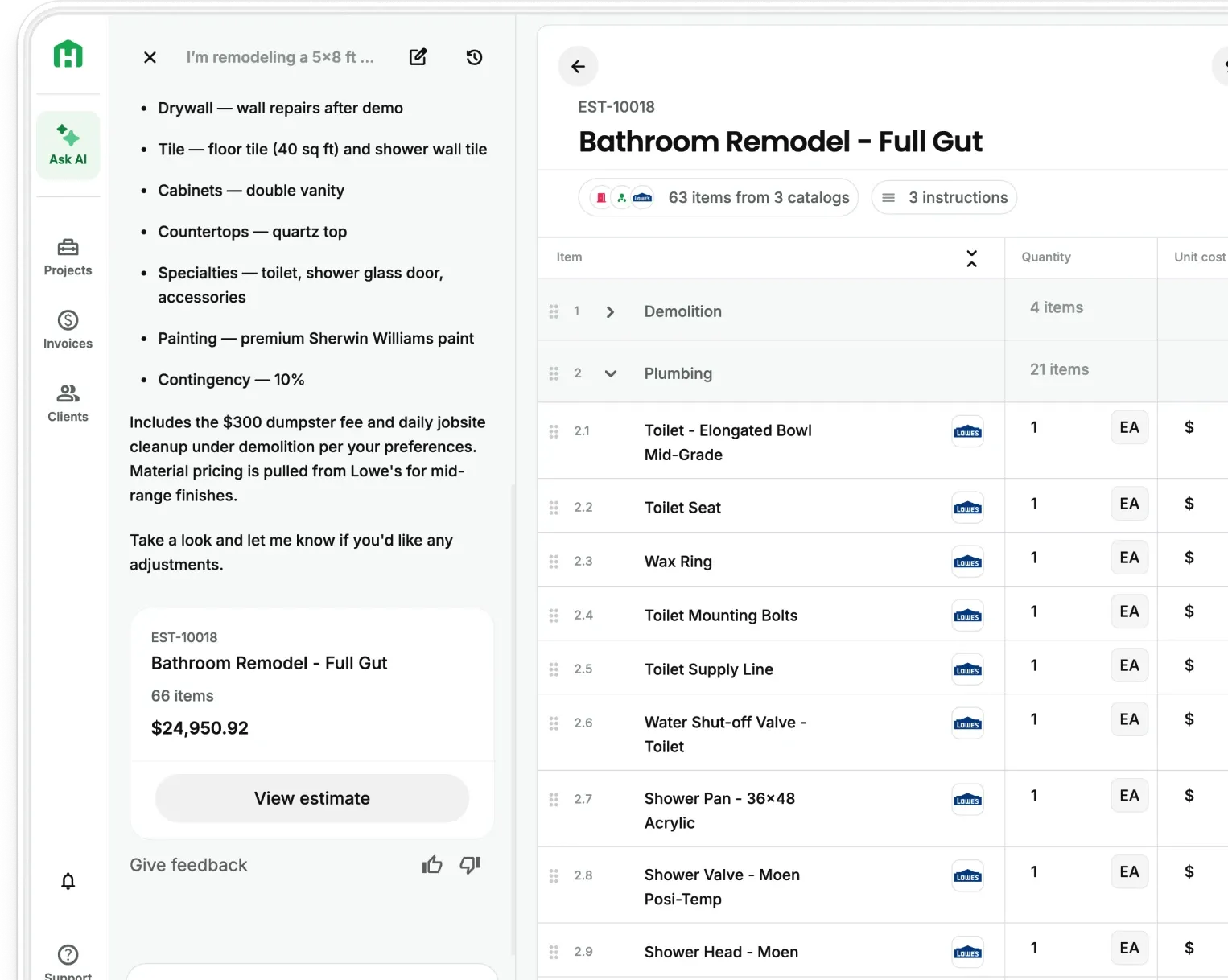
Here's what usually happens the first time a contractor tries AI estimating. You run a job you already know the answer to. Something you've bid a dozen times, like a standard bathroom gut and remodel. You compare the AI number to what you would have written by hand.
If it's close, you run another one. And another. That's not a data science process. It's the same way you'd trust a new subcontractor or a new supplier. You don't hand them your biggest job first. You give them something small, watch what they do with it, and build confidence from there.
The tools that earn long-term trust are the ones that hold up under that kind of scrutiny, not the ones that promise perfection on day one.
Where the number comes from matters
Not all AI estimating works the same way, and that's a big part of why some contractors trust it and others don't.
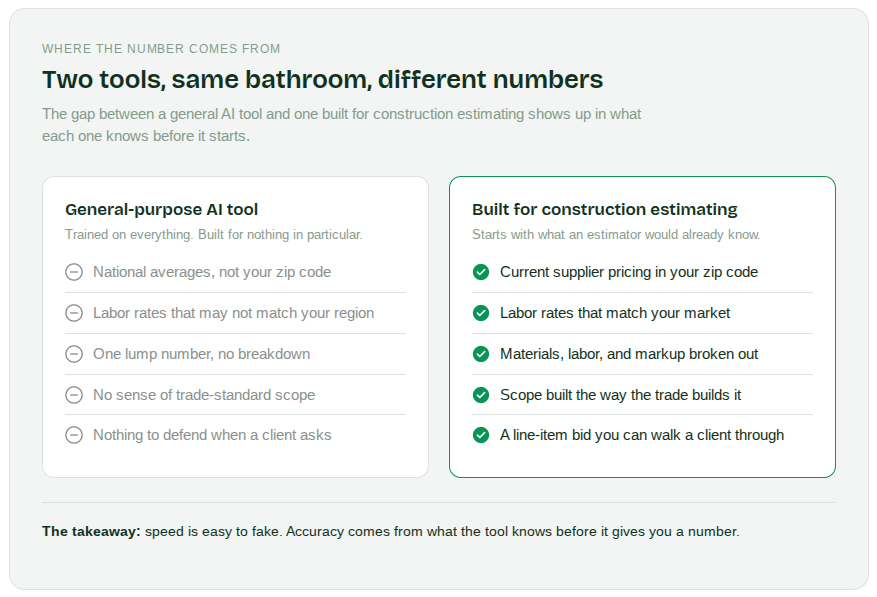
A general-purpose AI tool that wasn't built for construction is guessing. It doesn't know your local material prices. It doesn't know that a kitchen remodel needs an allowance for unknown electrical behind the wall. It's pattern-matching off whatever it was trained on, which might be nothing close to your market or your trade.
A tool built specifically for construction estimating works differently. It's pulling from current supplier pricing in your zip code, applying labor rates that match your region, and structuring the bid the way an estimator would, with materials, labor, and markup broken out instead of one lump number. That's the difference between a tool that's useful and one that's just fast.
What "accurate enough" actually means for a $25,000 bathroom
Accuracy doesn't mean the estimate matches the final invoice down to the dollar. No estimate does that, whether it's built by hand or by AI. Change orders happen. Homeowners change their minds about tile. A wall opens up and there's rot behind it.
Accurate enough means the estimate reflects the real scope of the job and the real cost to build it, so your margin holds up when the work is done. It means you're not eating a loss because a line item got missed on a fast walkthrough, or because the material price you used was pulled from a catalog that hadn't been updated since spring.
That's the bar AI estimating needs to clear. Not perfection. A number you can stand behind when a client asks you to defend it, and a number close enough to reality that your business stays profitable.
The part that still needs you
No tool, AI or otherwise, can walk your job site for you. It can't see the water stain in the crawlspace that tells you there's a plumbing issue nobody mentioned. It can't read a homeowner's tone when they say "we're flexible on the budget" and know they're not.
That judgment is yours. It's the reason clients hire you instead of ordering a kitchen remodel off a website. What AI estimating does is take the mechanical work off your plate, the measuring, the pricing lookups, the formula-checking, so you have more time to spend on the parts of the job that actually need a person who's done this before.
So, can AI produce accurate estimates?
Yes, when it's built for construction and you're giving it clear information to work with. The research backs that up, and so do the results contractors are seeing on real jobs.
But the more useful question is the one you started with. Not whether the tool is accurate in general, but whether it's accurate for your jobs, in your market, often enough that you can stop double-checking every number by hand.
That's not something a blog post can answer for you. It's something you find out by running a few estimates and comparing them to what you already know.
Try Handoff free for 7 days and see how the numbers hold up against your own bids.
Other FAQs we hear about the accuracy of AI Estimates
Should I still double-check an AI estimate before sending it?
Yes, at first. AI needs to be trained. Treat it the way you'd treat a bid from a new estimator. Review it, compare it to a job you know well, and once you've seen it hold up a few times in a row, you can start trusting it with less review.
Can AI estimating account for a job site it hasn't seen?
It can work from what you give it: photos, a plan, or a written description of the space. It can't account for what isn't visible, like hidden plumbing or structural issues behind a wall. That part still comes from your walkthrough and your experience.
Why do two AI estimating tools give me different numbers for the same job?
It usually comes down to what the tool was built for and where its pricing comes from. A tool trained on construction data and pulling live, local material pricing will land closer to reality than a general-purpose AI tool applying national averages or generic assumptions.