


What AI takeoff software can read on your plans
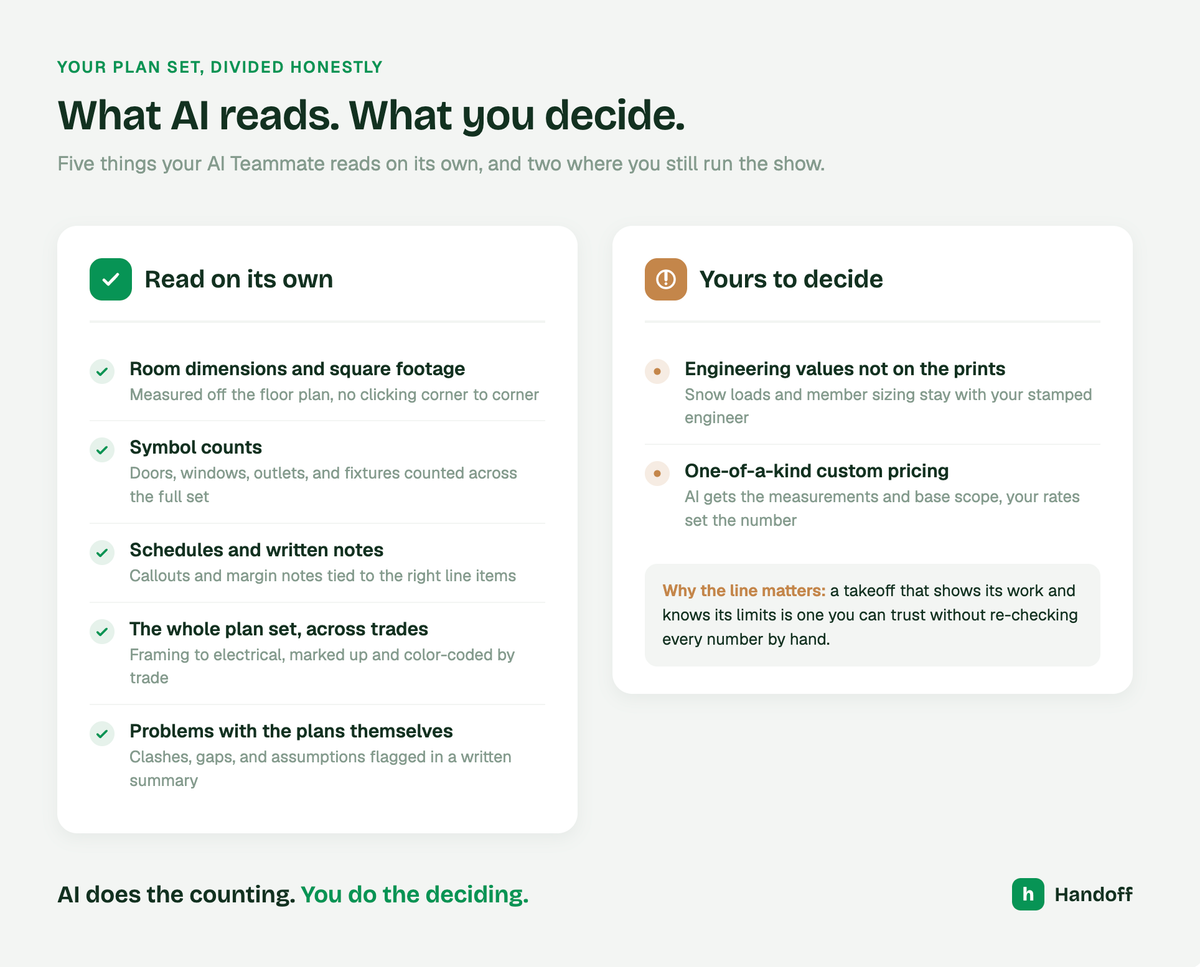
- Room dimensions and square footage. Every room gets measured off the floor plan. That means no manual scaling, no clicking corner to corner for an afternoon.
- Symbol counts. Doors, windows, outlets, fixtures, and connectors get counted across the full set, so nothing gets missed because it sat on page 14.
- Schedules and written notes. Door and window schedules, finish callouts, and margin notes get read and tied to the right line items. If your architect wrote it on the prints, it's in the takeoff.
- The whole plan set, across trades. Architectural, structural, elevations, foundation — framing, roofing, siding, flooring, and electrical all come back marked up and color-coded by trade.
- Problems with the plans themselves. Clashes between sheets, missing information, and any assumptions made during processing get flagged in a written summary, so you know exactly what to verify before the bid goes out.
A takeoff that once took 8 to 16 hours of clicking through drawings comes back in about two hours as a color-coded PDF you can show a client. Your AI Teammate does the counting; you do the deciding.
What AI can't read on construction plans
The two places your judgment still runs the job
- Engineering values that aren't written down. One custom-home builder asked us point blank: what about snow loads and framing member sizes? Here's the honest answer. If your engineer specified it on the prints, AI reads it and carries it through the takeoff. If it still needs to be calculated, that's a stamped-engineer decision — no software should be making it, and ours won't pretend to.
- One-of-a-kind custom work, priced blind (kind of). A $200,000 custom deck with a roof, custom rails, and under-deck skirting isn't a pattern-match job. AI gets you the measurements and the base scope fast, but your specialty pricing has to come from you which is why you can load your own catalogs and rates so the numbers reflect what your suppliers actually charge, not a national average.
Knowing the limits is what makes the rest trustworthy. Accurate estimates protect contractor margins from the start.
AI takeoff accuracy on residential plans
- Handoff’s AI Takeoffs were trained on residential construction, including completed estimates from real projects, not generic internet data
- Built for residential plan sets up to 7,000 square feet, which covers nearly every kitchen, bath, addition, and custom home a remodeler or GC bids
- Pricing tied to supplier data and local labor rates rather than static cost books, which matters when RSMeans data from Gordian shows material and labor costs shifting quarter to quarter
- Assumptions get flagged, not buried or “hallucinated”. The takeoff tells you what it guessed so you can confirm or correct it
The National Association of Home Builders has tracked for years how thin remodeling margins run; a missed scope item on a $40,000 job can erase the profit entirely. A takeoff that shows its work protects the number you bid.
Why contractors lose money on takeoff mistakes
Most takeoff losses trace back to one of three habits: rushing the count at night after a full day on site, outsourcing to a supplier and getting back a lumber list with no visibility into how quantities were figured, or skipping line items on the pages nobody re-reads. Harvard's Joint Center for Housing Studies puts annual U.S. remodeling spend near half a trillion dollars, and the contractors capturing their share of it are the ones whose bids are complete the first time.
- Outsourced takeoffs run $700 to $1,000 per job and take one to two weeks. The lead cools while you wait
- Self-performed takeoffs eat 8 to 16 hours you don't have, usually at the kitchen table
- Every missed item becomes a cost you eat or an awkward change-order conversation you don’t want
Fast estimates lead to more bids submitted per week, and complete estimates keep the jobs you win profitable.
5 steps to getting an accurate AI estimate from complex or unusual plans
- Upload the full set, not just the floor plan — elevations, structural sheets, and schedules all feed the takeoff.
- Add what only you know. A voice note or a few typed lines about site conditions, custom details, or your standard exclusions gets read right alongside the drawings.
- Load your catalogs and labor rates so pricing comes from your suppliers and your market, not a generic average.
- Read the flagged assumptions first. The written summary tells you what was inferred and where the plans conflict. Start your review there.
- Spot-check the big-ticket lines. Five minutes on the ten most expensive items catches more than an hour of re-reading everything.
Do those five things and the unusual jobs stop being the scary ones. Handoff removes the guesswork from pricing a job.
Put your residential plans to the test
The fastest way to find out what AI reads on your plans is to feed it yours:
- Start a free trial — no credit card needed
- Upload a residential plan set up to 7,000 sqft from a job you've already bid, so you can compare against numbers you know
- Review the color-coded takeoff and the flagged assumptions
- Check it against what your manual takeoff found and what it missed
You already know your trade. The takeoff shouldn't be the thing keeping you at the desk until midnight. Handoff reads the plans so you can run the jobs.
Other FAQs about how AI Takeoffs work for residential construction
Does AI takeoff work for plans over 7,000 square feet?
AI Takeoffs are tuned for residential plans up to 7,000 square feet, where accuracy is highest. For larger projects, you can still generate estimates from uploaded files — just plan on a closer review of the output, the same way you'd double-check a new estimator's first big job.
Can AI read hand-drawn or scanned plans?
Yes, if they're legible. Which is a very broad term. Our software can read even the worst handwriting. Upload a clean scan or photo as a PDF and dimensions, notes, and counts get extracted. The cleaner the scan, the tighter the takeoff — a coffee-stained fourth-generation copy might need more of your review.
Do I still need to review an AI takeoff before I bid?
Yes. The takeoff flags its assumptions so the review takes minutes instead of hours, but the bid carries your name and your margin. Review the flagged items, confirm the big-ticket lines, and send it.


