Every active job needs one place that holds its schedule, its scope, its changes, its costs, and what the client's been told. If that place is your memory, the business stops when you do.
It's 7:15 on a Thursday and your lead just texted: what does the scope say about the trim on the Park job?
You don't know offhand. It's in an email, or a note, or a conversation in a hallway three weeks ago. You scroll for ten minutes, find half of it, and text back your best guess.
That's four jobs running out of one phone, and it works right up until the week it doesn't.

What should you track on every job?
The Direct Answer: Every active job needs six things tracked in one place: the schedule, the scope and change orders, costs against the budget, crew hours, dated photos, and what the client's been told.
That's the list. Most contractors track two or three of them well and carry the rest in their head.
- The schedule: Phases in order, with who's on each one
- The scope and every change order: Signed and dated, not agreed to in a hallway
- Costs against the budget: So you see a job going over while you can still fix it
- Crew hours: Tied to the job rather than the week
- Photos and daily logs: Dated, so there's a record of what actually happened
- Client communication: So the homeowner has somewhere to look besides your texts
Here's the better test: can somebody other than you answer a question about the job in under a minute? If your lead can check the scope and your office person can see what's been billed, you've built a real system. If the answer is always "let me look," you are the system.
How do you know when you've outgrown your phone?
The Direct Answer: When you start losing track of what's outstanding rather than when you hit a specific number of jobs.
There's no magic job count. Two jobs you know cold isn’t a tracking problem. You should be concerned if these signs have started happening:
- You're scrolling text threads to find what you agreed to
- A change order got done and never got written up
- You're not sure which client is waiting on you for what
- Your lead calls you 3x a day for information that exists somewhere
- You found out a job went over budget from the final invoice
The typical remodeling firm runs about five employees.
Source: NAHB Eye on Housing, member census
At that size there's no project manager keeping any of this straight, no operations lead, and no one whose job is to update a system. Which is why the system has to hold itself up. If it depends on you remembering to feed it, it'll be out of date by Thursday.
What's the difference between a schedule and a job tracker?
The Direct Answer: A schedule tells you when work happens. A job tracker holds everything the work depends on, which is why a calendar by itself stops working once you're running more than a couple of jobs.
Plenty of contractors try to solve this with a shared calendar and a group text. It's a reasonable first move, and it breaks in a specific way.
A calendar holds dates. It can't tell your lead what the scope covers, what the client approved, or whether the tile came in. A group text holds conversation. ****It has everything in it and nothing you can find, because there's no structure to search. A job tracker holds the job. Scope, schedule, changes, costs, photos, and client history in one record, attached to the address instead of scattered across four apps.
How does a job tracking app pay for itself?
The Direct Answer: It pays for itself in the change orders you stop forgetting to bill and the jobs you catch going over budget while there's still work left to adjust.
- The unbilled change order: You agreed to move a drain in a hallway on a Tuesday. It never got written up, so it never got billed. One of those a quarter costs more than the software.
- The job you caught late: Costs land against the budget as they happen instead of at closeout, so a job trending over shows up in week three rather than in the final invoice, when there's nothing left to do about it.
- The hours nobody counted: Crew time tied to the job tells you what your labor actually runs, which is the number most small shops are estimating from memory.
- The questions you stopped answering: Every call your lead doesn't have to make is fifteen minutes back on a day you were already behind.
A job living in one place can be handed to someone else. A job living in your memory can't.
What should you look for in a contractor job tracking app?
The Direct Answer: Look for one built for residential remodeling, that works on a phone, and that fills itself in from work you're already doing rather than asking you to maintain it.
Three questions will eliminate most of the market fast.
- Was it built for a shop your size? Tools built for commercial general contractors assume a project manager, a superintendent, and a prequalification process. If the demo shows an org chart you don't have, the software will spend your time instead of saving it.
- Does it work on a phone? You'll use it on site and at the supply house. A tool that really wants a desk will get updated on Sundays, which means never.
- Does it fill itself in? This is the one that decides whether you're still using it in March. The estimate should become the schedule and the budget. A photo should become a daily log. Hours should land against the job as they happen.
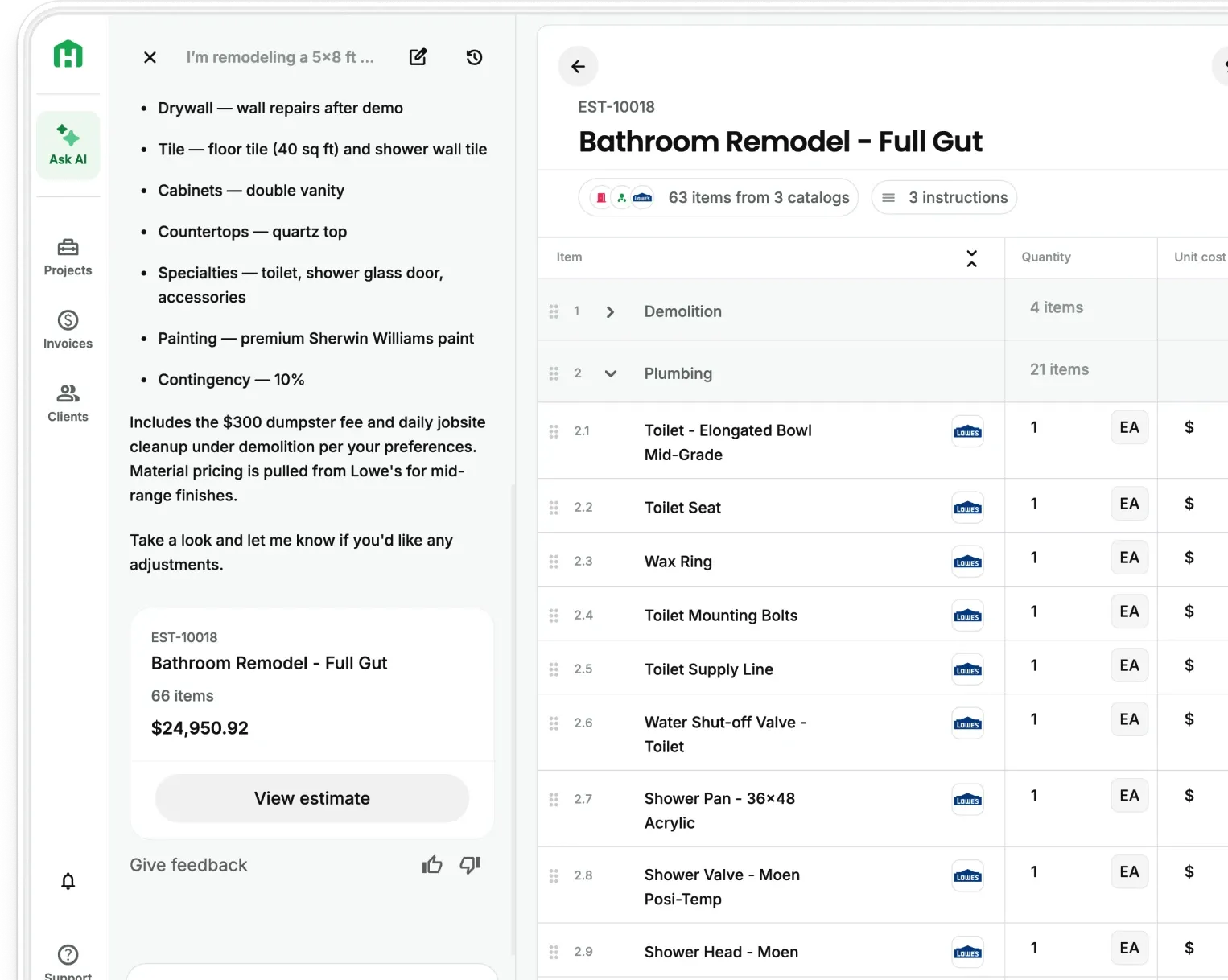
That last point is what AI actually changes here. Handoff's project management is built so the record is a byproduct of the work: AI Scheduling builds the schedule from your estimate, AI Daily Logs turn a photo or voice note into a dated entry, Time Tracking ties crew hours to the job, and the AI Client Portal gives homeowners their own view so their questions stop landing on you at 8pm. You can also just ask your AI Teammate which jobs are over budget and get an answer built from your own records.

How do you move your jobs over without losing a week?
The Direct Answer: Move one active job, not all of them. A full migration is a weekend you don't have.
- Pick the one active job generating the most questions
- Put its schedule, scope, and open change orders in one place
- Give your lead and the client access to their parts of it
- Count the questions that still come to you by Friday
- Move the next job only when the count drops
If the number of interruptions falls, you've proven it on one job at almost no cost. If it doesn't, you've learned exactly which piece of information is still living only in your head, which is worth knowing either way.
Want to try it on one job? Start free for 7 days and put your busiest active job somewhere your crew and your client can both see it.
Other FAQs about tracking jobs across multiple projects
Can you track jobs in a spreadsheet?
For one or two jobs, yes. Spreadsheets break on the two things that matter most here: they don't hold photos and documents well, and nobody updates them from a job site. The moment your crew needs to read it on a phone, a spreadsheet stops being the answer.
Do your subs and clients need their own logins?
They shouldn't have to buy anything. Look for a tool where a client can open their project from a link and a sub can see the scope and submit a bid without taking a paid seat on your plan. If every person you work with costs you a seat, you'll end up keeping half of them outside the system, which defeats the purpose.
What's the difference between job tracking and job costing?
Job tracking covers the whole job: schedule, scope, changes, communication. Job costing is the money piece specifically, comparing what you're spending against what you estimated. You want both, and they should sit in the same record so a change order updates the budget instead of just the paperwork.