


The guy who predicted AI would wipe out entire job categories just walked it back. Last week, OpenAI CEO Sam Altman said he was "pretty wrong" about AI's impact on white-collar employment. That he underestimated how much the human part of work actually matters. He called himself "delighted to be wrong."
For contractors, that headline might get a laugh. You weren't worried about AI taking your job. You were worried about not having enough people to do the jobs you already have.
The real staffing crisis in residential construction
According to the Associated Builders and Contractors, the U.S. construction industry needs to hire 349,000 net new workers in 2026 alone (on top of normal replacement hiring) just to meet demand. A significant chunk of that demand comes from experienced workers retiring, not from new projects being added. The people who know how to do the work are leaving, and the pipeline to replace them isn't keeping up.
For a small remodeling contractor running a 2–3 person crew, this shows up in a specific way: you land the work, then scramble to staff it. You take on a job before you've confirmed your sub is available. You price a project for a four-week timeline and then watch it stretch to seven because the right people weren't lined up from the start.
The real problem is you're scheduling jobs before you fully understand them. Not AI.
How better estimates lead to fewer staffing surprises
When an estimate is vague, the schedule that follows it is vague. And a vague schedule is a crew management nightmare.
A line-item estimate that spells out exactly what's happening in each phase — demo, rough-in, drywall, trim, tile — lets you schedule the right people for the right days before you ever sign the contract. Your framing sub knows when they're needed. Your tile guy isn't showing up to a job that isn't ready. Your materials are ordered on time because you know what phase starts when.
The contractors who struggle most with crew management are the ones whose estimates are too rough to build a real schedule around.
An AI Teammate doesn't replace your crew. It builds the detailed scope that makes your crew's time worth showing up for.
AI and the trades — what it actually automates
Nobody is sending a robot to hang drywall or set tile. The work that requires a licensed, experienced pair of hands on a job site isn't going anywhere, especially in a market this short-staffed.
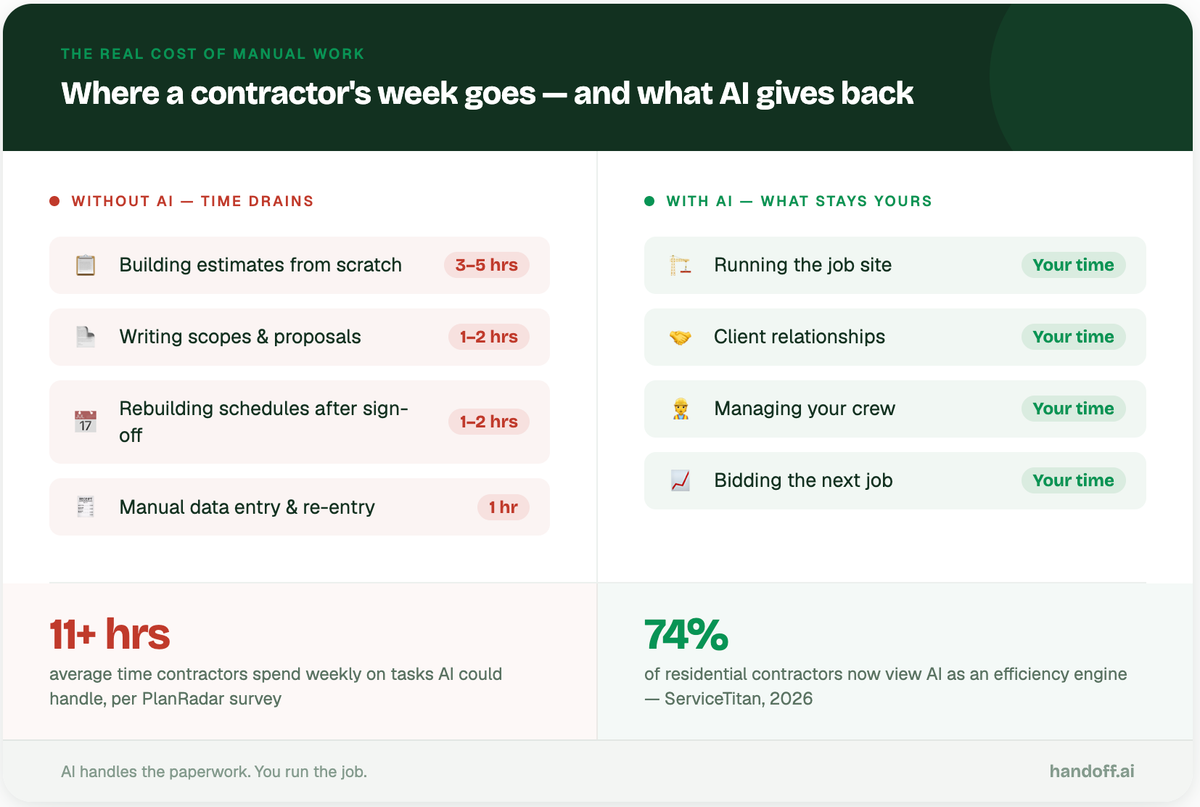
What AI automates is the paperwork that drains your evenings:
- The three hours of estimate building that could be 20 minutes
- The scope of work that writes itself from the estimate
- The proposal formatting, the invoice triggers, the follow-up sequences
- The schedule that gets built from the line items instead of rebuilt from scratch
That's time you get back. According to ServiceTitan's 2026 Residential State of the Trades Report — a survey of 1,000 residential contractors — 74% of contractors see AI as an efficiency engine, and early adopters already report measurable gains in productivity and time savings. Not because it replaces the trade work, but because it handles the administrative work that eats the hours around it.
The contractors who win in a tight labor market
In a market where every good sub is in demand and your competition is fighting for the same crew, the contractors who win aren't the ones who pay the most. They're the ones whose jobs run cleanly.
Clean schedules. Clear scopes. No surprises mid-project. Subs come back to contractors who have their act together — because their time isn't wasted on jobs that weren't planned properly from the start.
AI doesn't solve a labor shortage. But it does solve the planning problem that makes the labor shortage feel worse than it already is.
Sam Altman was wrong about AI taking jobs. He got that one right, eventually. For contractors, the question was never about jobs — it was about whether the tools are actually useful. The ones that handle your estimates, your scheduling, and your paperwork while you run the job? Those are.
Other FAQs about AI in the construction industry
Will AI make the construction labor shortage worse?
The opposite is more likely. AI handles the administrative work that currently takes experienced contractors off the job site — estimating, scheduling, proposals, paperwork. When that time comes back, you can run more jobs with the same crew instead of hiring to cover the overhead. In a market where 349,000 new construction workers are needed in 2026 alone, the contractors who get more out of the people they already have are the ones who stay competitive.
How does AI estimating software help with crew scheduling?
A detailed line-item estimate is the foundation of a reliable schedule. When you know exactly what's happening in each phase — demo, rough-in, drywall, trim — you can put the right people on the right days before you sign the contract. Vague estimates produce vague schedules, and vague schedules are where crew management falls apart. AI estimating gives you the detail you need to plan the job before it starts.
How accurate is AI estimating software for residential remodeling?
AI estimating is accurate enough to use on real jobs — but only when the tool is built specifically for residential construction, not a generic AI retrofitted for it. Purpose-built platforms use local, real-time pricing data calibrated to your market rather than national averages, which is where most accuracy problems originate. The contractors who get the most accurate results are the ones who give the AI a complete scope to work from. But the tool is only as good as the inputs you give it.
Ready to win more jobs with less manual work? Try Handoff free →


