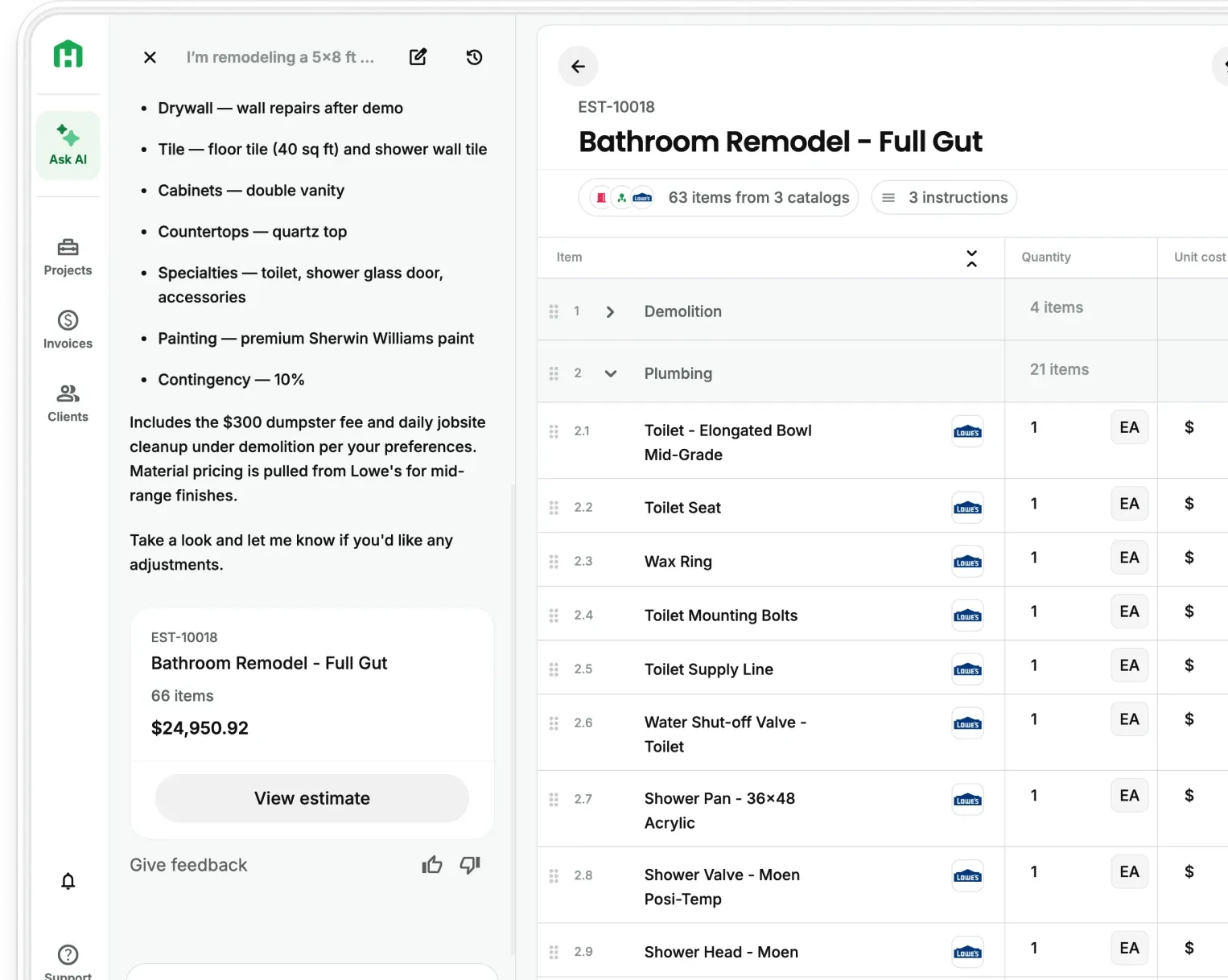
When you're estimating by hand, accuracy isn't a guarantee. It's a guess dressed up in a spreadsheet. But, at the end of the day, you trust yourself more than that chat bot that’s gotten your markup costs wrong now for the third time. So how do you pair accuracy without doubling your processes?
Long story short, AI estimating is accurate enough to trust for residential work but only when the tool is purpose-built for construction, not a generic AI retrofitted with a spreadsheet. The real question isn't whether AI is accurate. It's whether your current process is. If you're estimating from memory, tracing blueprints by hand, or pricing from last quarter's supplier catalog, the risk is already on your plate.
Why manual estimating has an accuracy problem
Before weighing AI accuracy, it helps to know what you're comparing it to.
Manual estimating relies on three things that are all prone to failure:
- Human memory — Estimating errors alone account for 32% of all construction cost overruns, according to research from Compass International. That's a structural problem in how bids are getting built.
- Spreadsheets — The spreadsheet issue is particularly stubborn. Approximately 88% of all spreadsheets contain errors in their formulas. That’s solvable both for the human and a bot.
- Static pricing data — Your estimate is now a time bomb. The moment materials move, your margin disappears and you don't find out until you're mid-job.
Where manual work break down:
- Takeoffs done by hand introduce measurement errors that compound across line items
- Pricing lookups are slow, often outdated, and frequently skipped under deadline pressure
- Scope items get missed during fast site walks — a bathroom, a window, a structural detail
- Spreadsheet formula errors go undetected until a job is already underway
None of this is to say experienced estimators aren't good at their jobs. But, the tools they're using weren't built to catch the mistakes humans naturally make when they're tired, rushed, or working from incomplete information.
How accurate is AI estimating for construction companies?
The short answer: more accurate than manual methods, and getting better.
A peer-reviewed study documented 20.4% better accuracy, 51.3% faster completion, and 28.4% improved coordination when firms adopted AI-assisted estimating workflows. Those aren't marginal improvements. On a $40,000 kitchen remodel, a 20% accuracy improvement is the difference between a job that makes money and one that doesn't.
What AI estimating does differently:
- Reads blueprints, photos, and drawings without fatigue or distraction
- Counts every door, window, and structural element without skipping
- Applies current, localized material pricing automatically — not last month's catalog
- Builds complete line items including materials, underlayment, labor, and markup
The important caveat: accuracy depends heavily on the quality of the input. A blurry photo or an incomplete floor plan will produce a less accurate estimate. The tool is only as good as what you give it, which is true of any estimating process, manual or automated.
Where AI estimating still needs human judgment
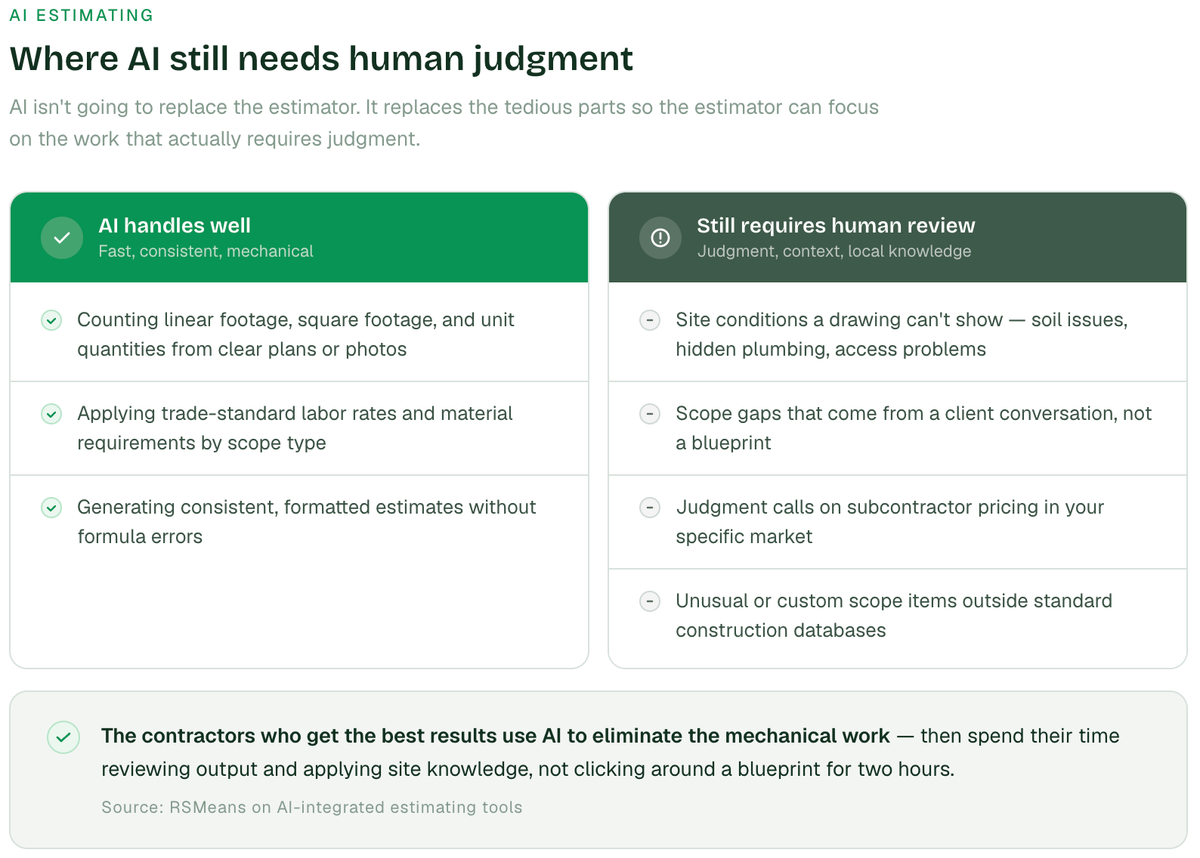
AI ins’t going to replace the estimator. It replaces the tedious parts so the estimator can focus on the parts that actually require judgment.
AI handles well:
- Counting linear footage, square footage, and unit quantities from clear plans or photos
- Applying trade-standard labor rates and material requirements by scope type
- Generating consistent, formatted estimates without formula errors
Still requires human review:
- Site conditions a drawing can't show — soil issues, hidden plumbing, access problems
- Scope gaps that come from a client conversation, not a blueprint
- Judgment calls on subcontractor pricing in your specific market
- Unusual or custom scope items outside standard construction databases
Even the best AI-integrated estimating tools require human oversight and input to ensure accuracy, according to RSMeans. The contractors who get the best results from AI estimating use it to eliminate the mechanical work and spend their time reviewing output and applying their site knowledge — not clicking around a blueprint for two hours.
Does it work for residential remodeling specifically?
This is where most accuracy discussions fall short. The research cited above largely covers commercial construction. Residential remodeling is a different environment.
Most kitchen and bathroom remodels don't come with formal blueprints. You walk the space, take notes, and go home to write a bid. A commercial AI takeoff tool built for 100-page plan sets won't help you there.
Handoff AI is built specifically for this reality. You can generate an estimate three ways:
- Upload a PDF blueprint — AI reads the plans and returns a line-item scope
- Type a project description — describe the job in plain language, get a structured estimate
- Upload job site photos — the AI identifies room dimensions, cabinet layout, countertop area, and flooring square footage from the images directly
That last capability matters most for residential work. No legacy tool offers photo-based takeoffs. For a closer look at how it works, see how Handoff generates estimates from drawings and photos.
Handoff also connects to supplier catalogs and applies real-time, localized pricing by zip code — so your estimate reflects what materials actually cost in your market today, not a national average from six months ago.
What Does Accuracy Mean in Practice?
Numbers help, but the real test is whether AI estimating holds up on actual jobs. Here's what Handoff users report:
- Gordon Williams of T2B Carpentry LLC cut his estimating time by 90%
- Harold Bailey of Mr. Fix-It reduced estimate time by 75%
- Tim O'Keefe of Keeler Construction went from 2 to 4 hours per estimate down to 20 minutes
Speed and accuracy compound. A faster estimate that goes out the same day you walk the job wins more work than a more precise estimate that takes three days. Most homeowners get two or three bids and the first professional proposal to land usually gets the job.
For a deeper look at how AI estimating affects profitability beyond accuracy, read how AI estimating helps contractors price projects more profitably.
More AI estimator FAQs
What causes AI estimating to be less accurate? Input quality is the main variable. A clear blueprint or a well-lit job site photo produces a more accurate estimate than a blurry image or an incomplete description. Site conditions that aren't visible in a drawing — hidden plumbing, structural surprises, difficult access — still require your judgment before you finalize a bid.
How does AI estimating handle material pricing? Purpose-built platforms like Handoff connect to live supplier catalogs and apply localized pricing by zip code. That means your estimate reflects current market rates, not a static database that was last updated six months ago.
How long does it take to get accurate results from AI estimating software? Most contractors using Handoff generate their first usable estimate within hours of signing up. Accuracy improves as the system learns your pricing preferences, markup patterns, and project types over time.
The bottom line
AI construction estimating is accurate enough to trust — more accurate, in fact, than the manual methods most residential GCs are still using. The research is clear. The contractor results back it up. The tools have matured enough that accuracy is no longer the barrier.
The real barrier is inertia. Most contractors know their current process has gaps. They've eaten a bad bid, missed a scope item, or sent a proposal three days after a competitor already closed the job. AI estimating doesn't eliminate the need for good judgment. It eliminates the tedious mechanical work that slows you down and introduces errors before you ever apply that judgment.
If your bids are taking days when they should take hours, Handoff was built to fix that.