


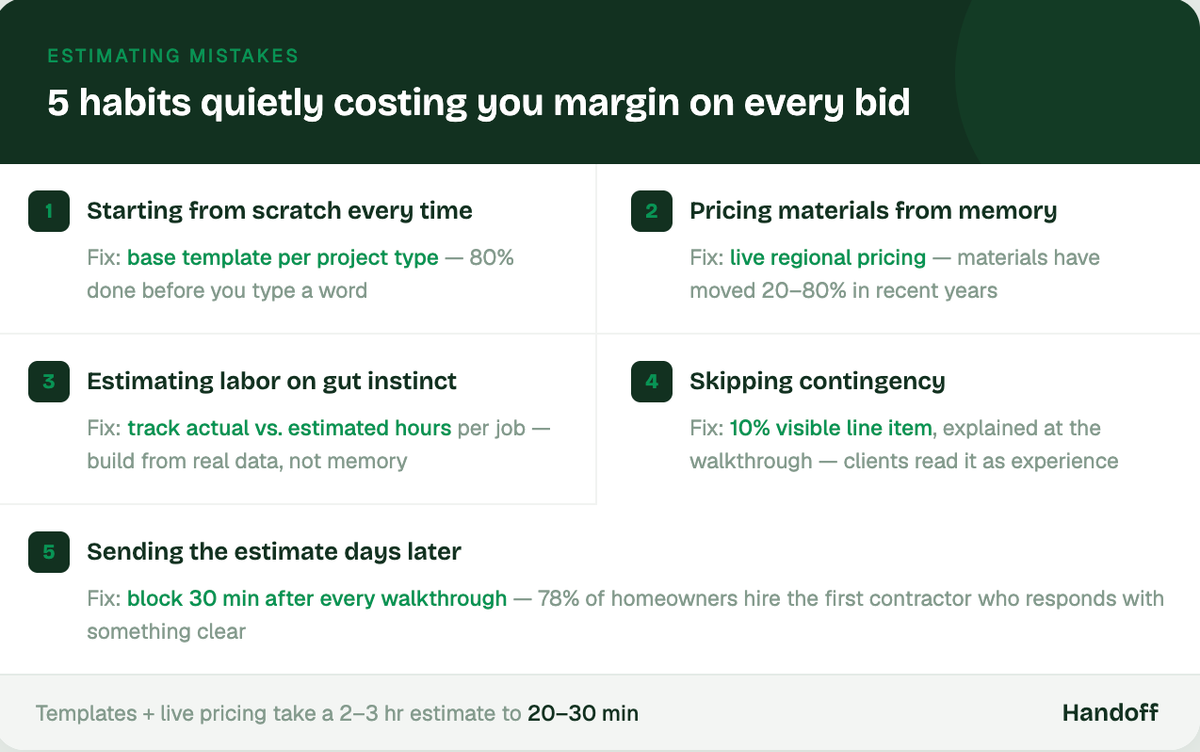
Most contractors making estimating mistakes aren't guessing randomly — they're following habits that made sense when they started but are quietly costing them time and margin now. The five mistakes below are the ones that show up most often: starting from scratch, pricing on memory, underestimating labor, skipping contingency, and sending estimates too late. Each one has a fix that doesn't require a complete overhaul, just a better system.
Starting every estimate from scratch — what it actually costs you
You finish a job and a new lead hits your inbox. Same scope as last month: bathroom remodel, double vanity, walk-in shower. You open a blank spreadsheet and start over.
It feels normal. It's also the single biggest time drain in most contractors' businesses.
Starting from scratch on a 200 sq ft bathroom remodel adds 1–3 hours per estimate. Across 20 bids a year that's up to 60 hours. Gone. And that's before counting the margin you lose when you miss line items you'd have caught in a template.
What building from scratch actually produces:
- Inconsistent pricing — without a baseline, your numbers shift job to job, which creates confusion for repeat clients and makes you look unprofessional even when your work isn't
- Missed line items — demo labor, disposal fees, cleanup, trim work. The details you know by heart are the ones most likely to get skipped when you're building on the fly at 9pm
- No delegation path — if the estimate lives only in your head, you can never hand it off
The fix is straightforward
- Identify your three to five most common project types and build a base estimate for each. Standard materials with markup, labor hours based on jobs you've already run, permits and contingency, add-on options.
- Save it.
- Next time that scope comes in, you're 80% done before you've typed a word. Your AI Teammate handles the rest. Pulling current prices, calculating quantities, and formatting the proposal so it's client-ready in minutes.
How outdated material prices quietly eat your margin
Material prices in construction move constantly. Lumber, drywall, copper, tile. All have swung 20–80% within months in recent years. Most contractors know this. Most are still pulling prices from memory or last year's spreadsheets.
The math is unforgiving. On a kitchen remodel quoting 120 sq ft of tile at $2.50 when it's running $4.10, and plywood at $80/sheet when it's $99. You're already $500–$1,000 under before the job starts. That's not a huge data problem.
What outdated pricing costs you in practice:
- You eat the difference. Underquote materials and you're covering the overage out of margin — or worse, out of pocket
- You scare off clients with overestimates. Pricing based on last year's highs makes your bid look inflated when a competitor is working from current numbers
- Change order conversations get harder. If you can't show where the price came from, clients push back
The fix isn't calling three lumber yards before every bid
- It's connecting your estimating process to live regional pricing data so the number in your proposal reflects what materials actually cost today.
- As a floor, update your pricing templates monthly. Even a manual review once a month catches the moves that matter most.
Why labor hours are the hardest part of an estimate to get right
Most contractors start labor estimates with gut instinct: "We can probably knock this out in 2–3 days." Gut instinct built on experience is useful. The problem is it doesn't account for the specific job in front of you — the layout issues, the client who's still living in the house, the material delivery that slips a day.
Every time your estimate says three days and the job takes five, the overage comes out of your margin. Run that pattern across a full year of work and the number adds up fast.
Three things that actually improve labor accuracy:
- Track actual vs. estimated hours on every job — even rough notes in a spreadsheet. Within a quarter you'll have a real picture of where your gut is right and where it consistently misses
- Build category-specific buffers — demo and haul-away almost always runs into day two. Tile layout almost always hits a snag. If you know that, build it in rather than hoping this job is different
- Account for site factors upfront — remodels in lived-in homes run slower than vacant spaces. Material delivery timing, weather exposure, and client decision delays all affect actual labor and rarely show up in a first estimate
After every job, the most useful question to ask your crew is simple: was this more or less time than we expected, and why? The pattern answers are the ones worth building into your next estimate.
How to include contingency without scaring off clients
Something always comes up. A pipe behind drywall that needs rerouting. A permit delay from the city. A material backorder that forces a scope change. If you didn't include contingency in your estimate, that something becomes a conversation you didn't want to have: asking the client for more money mid-project.
Most contractors skip contingency because they're worried about sticker shock. The ones who include it consistently close more jobs, not fewer, because clients read a clear contingency line as evidence of experience. It signals you've done this before and you're protecting both parties.
How to present it so it lands:
- Add a dedicated line item — label it "Project contingency (10%)" or "Unforeseen conditions allowance." A transparent line is more professional than a number that's quietly padded elsewhere.
- Explain it at the walkthrough, not in writing: "We include a 10% contingency for anything unexpected — if we don't need it, we'll credit it back or apply it to an upgrade." That framing makes the contingency feel like protection rather than a price increase.
- Track how often you use it. If you're pulling from contingency on most jobs, your initial scope planning needs tightening. If you rarely touch it, you've built exactly the right buffer.
A 10–15% contingency is standard for residential remodeling. Including it is reflecting the reality of how construction actually goes.
Same-day vs. next-week estimates — what the difference costs you in closed jobs
78% of homeowners hire the first contractor who responds with something clear and detailed. The contractor who sends a polished proposal same-day or next-day wins jobs that slower competitors never get a second look at.
What's actually behind the delay for most contractors:
- Building from scratch takes too long — back to mistake one
- Waiting to "make it look right" when the formatting should already be handled by the template
- No system for the hour after a walkthrough, so estimates sit in a notebook until there's time
The practical fix
- Blocking 30 minutes on your calendar immediately after every walkthrough — not "later this week."
- With a good template and current pricing already loaded, 30 minutes is enough to get a professional proposal out the door while the client is still thinking about the conversation you just had.
Mention it at the walkthrough: "You'll have a detailed proposal by 5pm today." That line closes jobs before the estimate even arrives. It signals the kind of operation you run.
There's more in the full guide
The blog covers the five mistakes. The guide goes deeper — a proposal review checklist, a template-building walkthrough for your five most common project types, and a labor tracking system you can start using this week.
Other FAQs about estimating mistakes
What's a realistic contingency percentage for a residential remodel? 10–15% is standard for most residential scopes. Jobs with more unknowns — older homes, occupied spaces, complex mechanical or structural work — warrant the higher end. The contingency line should be visible in the proposal, not baked silently into other line items.
How do you speed up the estimating process without sacrificing accuracy? Templates and current pricing data are the two highest-leverage moves. Templates remove the rebuild time; live pricing removes the guesswork. Together they take a 2–3 hour estimate down to 20–30 minutes on a familiar scope — without cutting corners on the numbers.
Ready to win more jobs with less manual work? Try Handoff free →


