

Why handyman lead generation is different from bigger contractors
Homeowners hiring a handyman make faster decisions than homeowners hiring a GC. The job is smaller, the trust barrier is lower, and the search usually starts on a phone. That means your lead generation doesn't need to be complicated, it really just needs to be present. A professional website, an active Google profile, and a few strong reviews will outperform most paid ad strategies for small handyman operations.
The mistake most handymen make is waiting for word-of-mouth to carry them. Word-of-mouth works, but only when there's something online to confirm what a neighbor just recommended. If a homeowner searches your name and finds nothing, they move on.
How to build a website that actually converts leads for a handyman
A website doesn't need to be elaborate to work. It needs to answer three questions a homeowner has when they land on it: what do you do, where do you work, and can I trust you?
What converts:
- Before-and-after photos of real jobs — not stock images
- Service pages for each trade you cover, with your city or service area in the page title
- A simple contact form or click-to-call button above the fold
- A few honest reviews pulled from Google or left directly on the site
The fastest way to improve existing copy: paste your homepage text into ChatGPT and ask it to rewrite it to be more customer-focused. Most contractors write about themselves — homeowners want to know what you'll do for them.
Building separate pages for each service and each town you work in is one of the highest-leverage SEO moves available to a small handyman business. A page titled "Bathroom Repair in [City]" will outrank a generic services page almost every time.
How to optimize your Google Business Profile for local leads
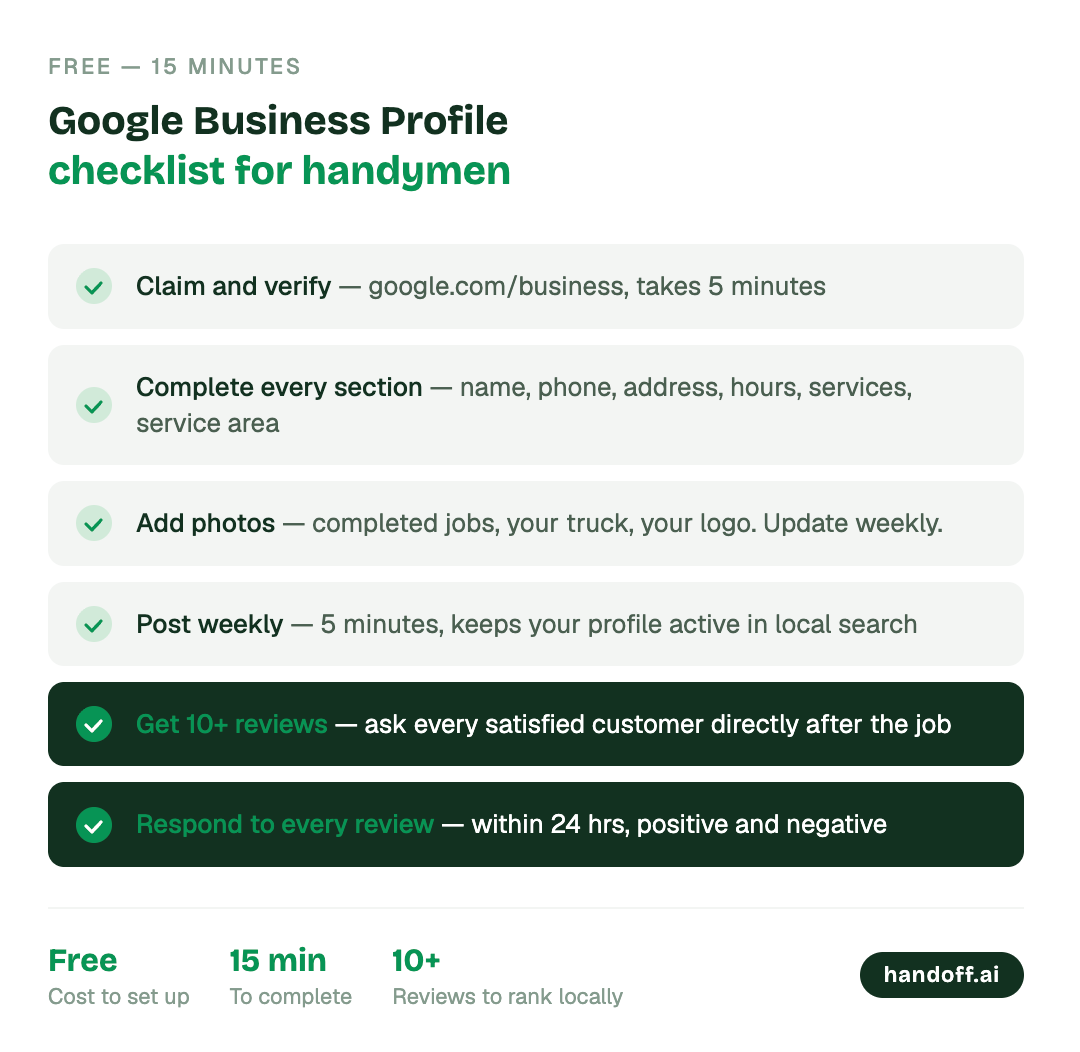
Your Google Business Profile is the single highest-return free tool available to a handyman. When someone searches "handyman near me," the local pack — those three listings that appear above the regular search results — is what they click first.
Getting into that pack requires:
- A complete profile with accurate name, phone, address, and service area
- At least 10 recent reviews, with responses from you on every one
- Photos updated regularly — completed projects, your truck, your logo
- A business description that mentions your key services and city
Use the Posts feature weekly. It takes five minutes and signals to Google that your profile is active. Respond to every review within 24 hours whether it’s positive or negative. Homeowners read how you handle criticism as much as they read the praise.
Claim your Google Business Profile here if you haven't already. It's free and takes about 15 minutes to set up.
Social media for handymen — what actually gets you leads
Most handymen either post too sporadically to build any momentum or post too much self-promotion and lose followers. The formula that works is simple: two helpful posts for every one that pitches your services.
What to post:
- Before-and-after photos with a one-sentence description of the job
- Quick tips ("here's how to tell if your caulk needs replacing")
- Short video walkthroughs of a completed project
- Seasonal reminders tied to maintenance tasks homeowners forget
Facebook and Nextdoor are the highest-value platforms for most handymen because the audience is local and actively engaged in neighborhood topics. Join local Facebook groups and introduce yourself. Offer a tip, answer a question, and mention your services once without making it a pitch.
Paid ads on Facebook are worth testing once your organic presence is solid. A simple ad showing a before-and-after with a "get a free quote" button, targeted to homeowners within 15 miles, can generate consistent leads for $10–20 per day.
Networking with realtors and property managers for steady handyman work
Realtors and property managers are repeat-business goldmines for handymen. A realtor listing three homes per month will need small repairs on nearly every one. A property manager with 20 units will need ongoing maintenance across all of them.
The pitch is simple: you're reliable, you respond fast, and you can handle the small jobs that bigger contractors won't prioritize.
How to start:
- Reach out to local realtors on Nextdoor or LinkedIn with a direct, brief message
- Offer a discounted rate for the first job to prove your reliability
- Follow up after each job with a thank-you and a reminder that you're available for their next listing
- Attend one local real estate networking event per quarter
One strong relationship with an active realtor can generate more consistent work than most paid advertising. It takes longer to build but it compounds and referrals from professionals carry more weight than most online reviews.
Here are 11 more ways you might want to peruse through too if you have time.
Referral programs that actually work for handyman businesses
Word-of-mouth is the most trusted lead source for any home service business. A referral program turns happy customers into an active sales channel instead of a passive one.
A simple structure that works:
- The referring client gets 10% off their next job
- The new client gets 10% off their first job
- You communicate it at the end of every completed project, and in your follow-up text or email
Make referring easy. Send clients a short text they can forward, a link to your Google profile for reviews, or a business card they can hand to a neighbor. The harder it is to refer you, the fewer referrals you'll get regardless of how good the incentive is.
Your AI Teammate in Handoff can automate the follow-up after a job closes — review requests, referral reminders, and check-in messages all go out on schedule without you having to remember to send them. One completed job becomes a referral engine instead of a one-time transaction.
Other handyman FAQs about getting more leads
How many leads does a handyman business need per month to stay busy?
It depends on your average job size, but most solo handymen need 8–15 new leads per month to maintain a full schedule when accounting for no-shows, price shoppers, and jobs outside your service area. A strong Google Business Profile and consistent reviews can generate that volume in most suburban markets without paid advertising.
Is Nextdoor worth using for handyman lead generation?
Yes — especially in suburban neighborhoods where homeowners actively ask for contractor recommendations. Nextdoor leads convert at a higher rate than most platforms because the trust is built in. A few recommendations from neighbors in a single neighborhood can carry you for months.
What's the difference between a lead and a qualified lead for a handyman?
A lead is anyone who contacts you. A qualified lead is someone whose job fits your service area, budget, and trade scope. The fastest way to qualify leads before spending time on a site visit is to ask three questions upfront: where is the job, what's the scope, and when do you want it done? Anyone who won't answer those three questions isn't serious.


